Tag Archives: Fred Hutchinson Cancer Research Center

Worse before Better

Standard

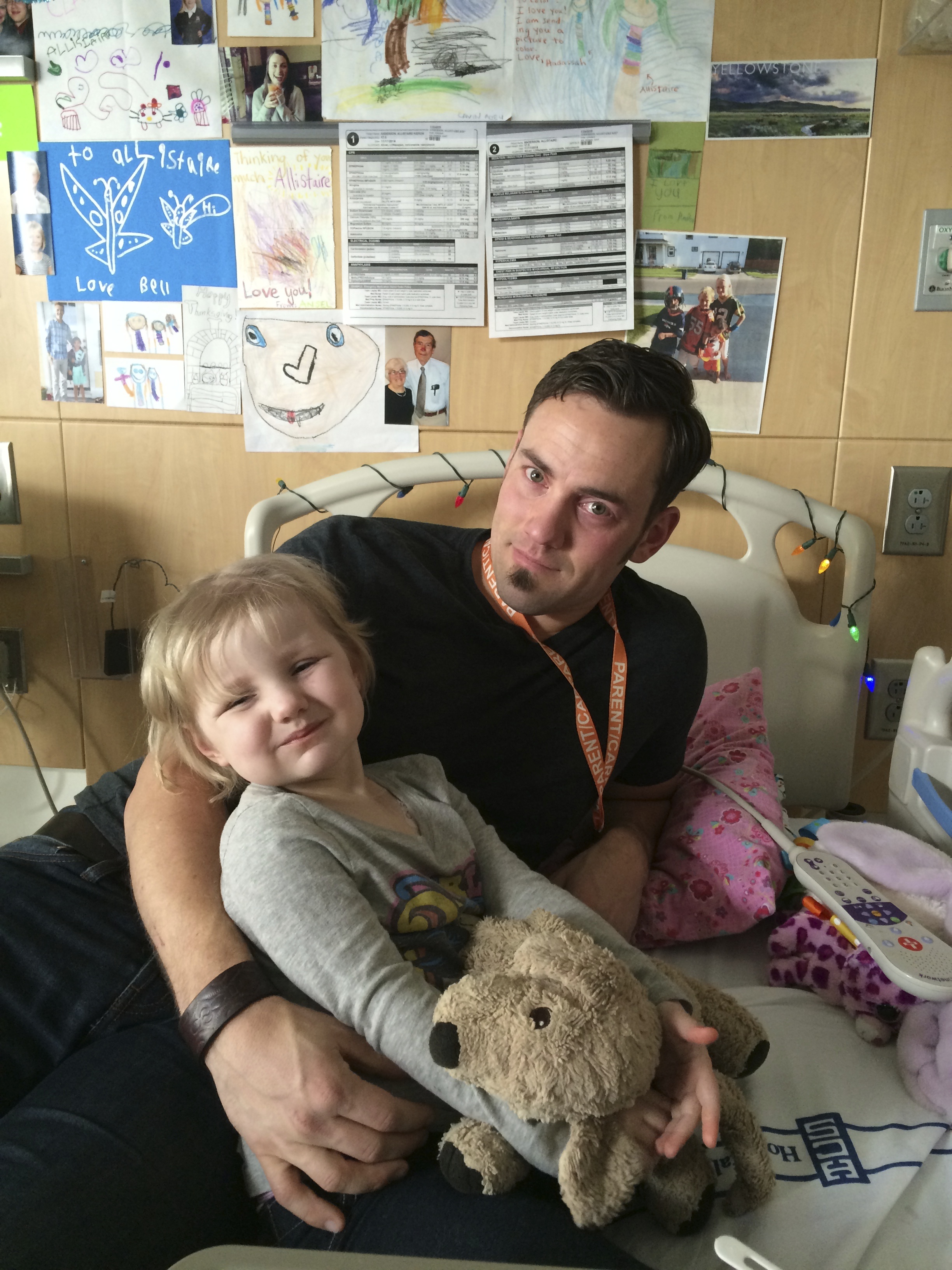
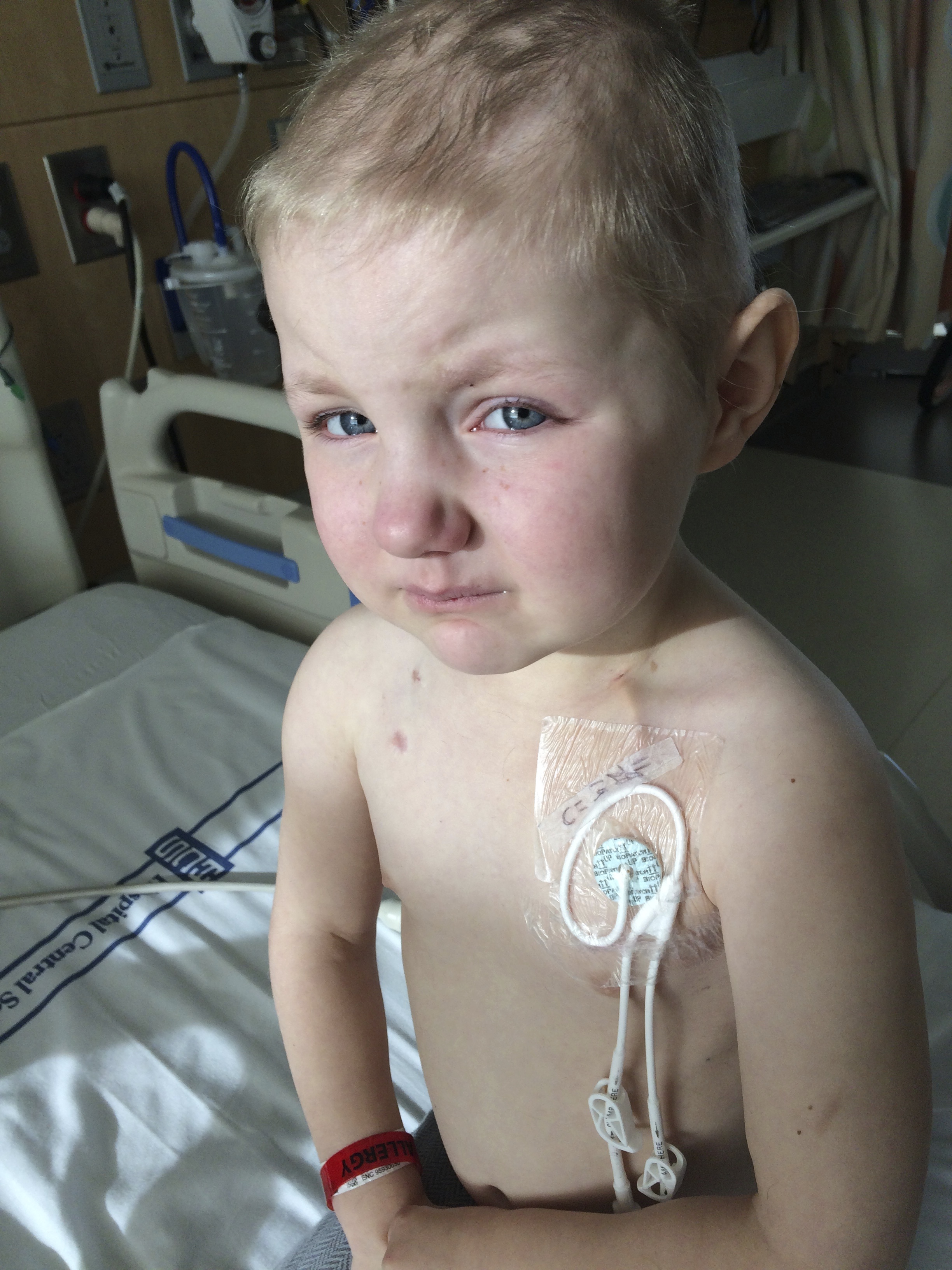
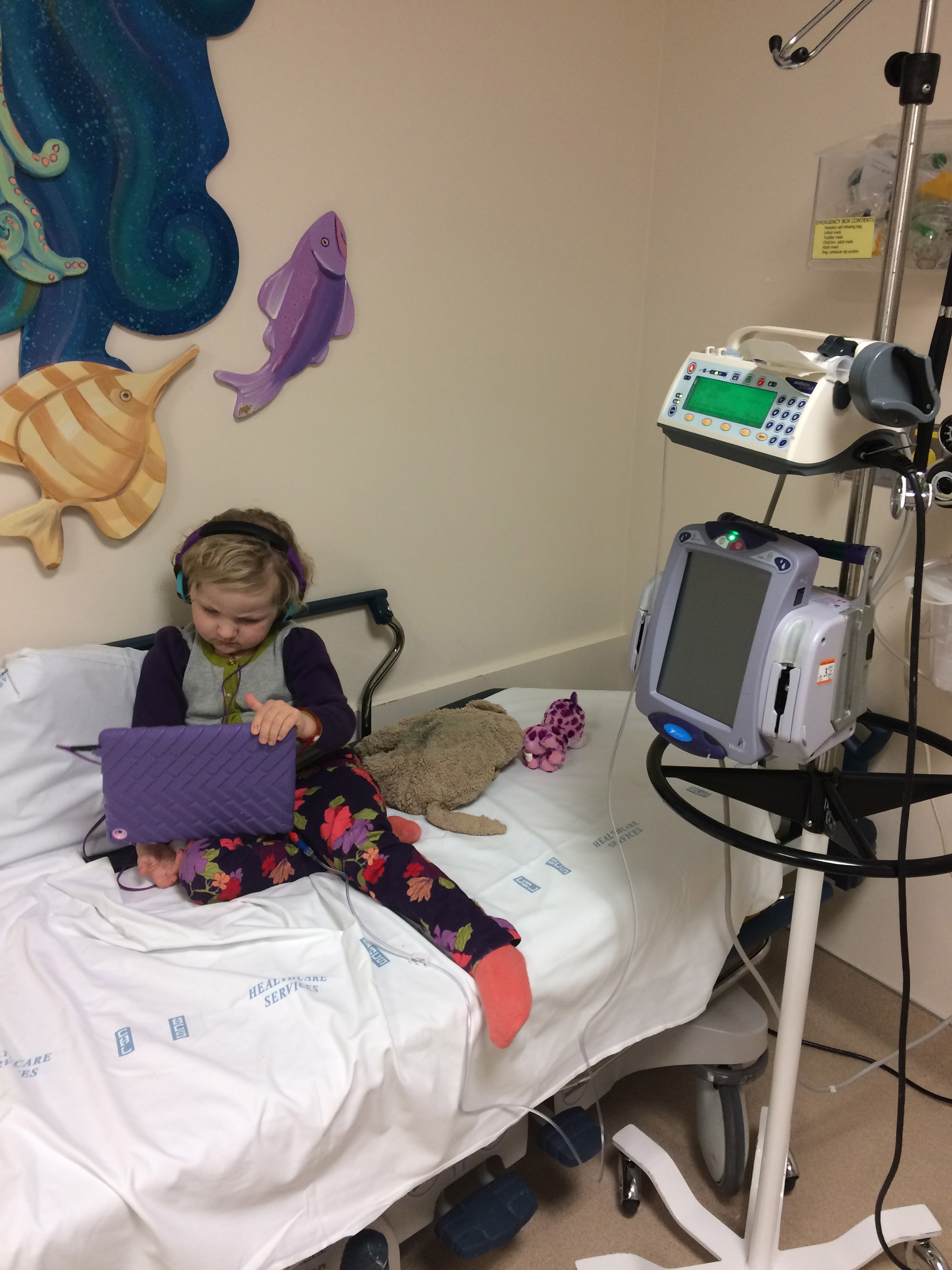
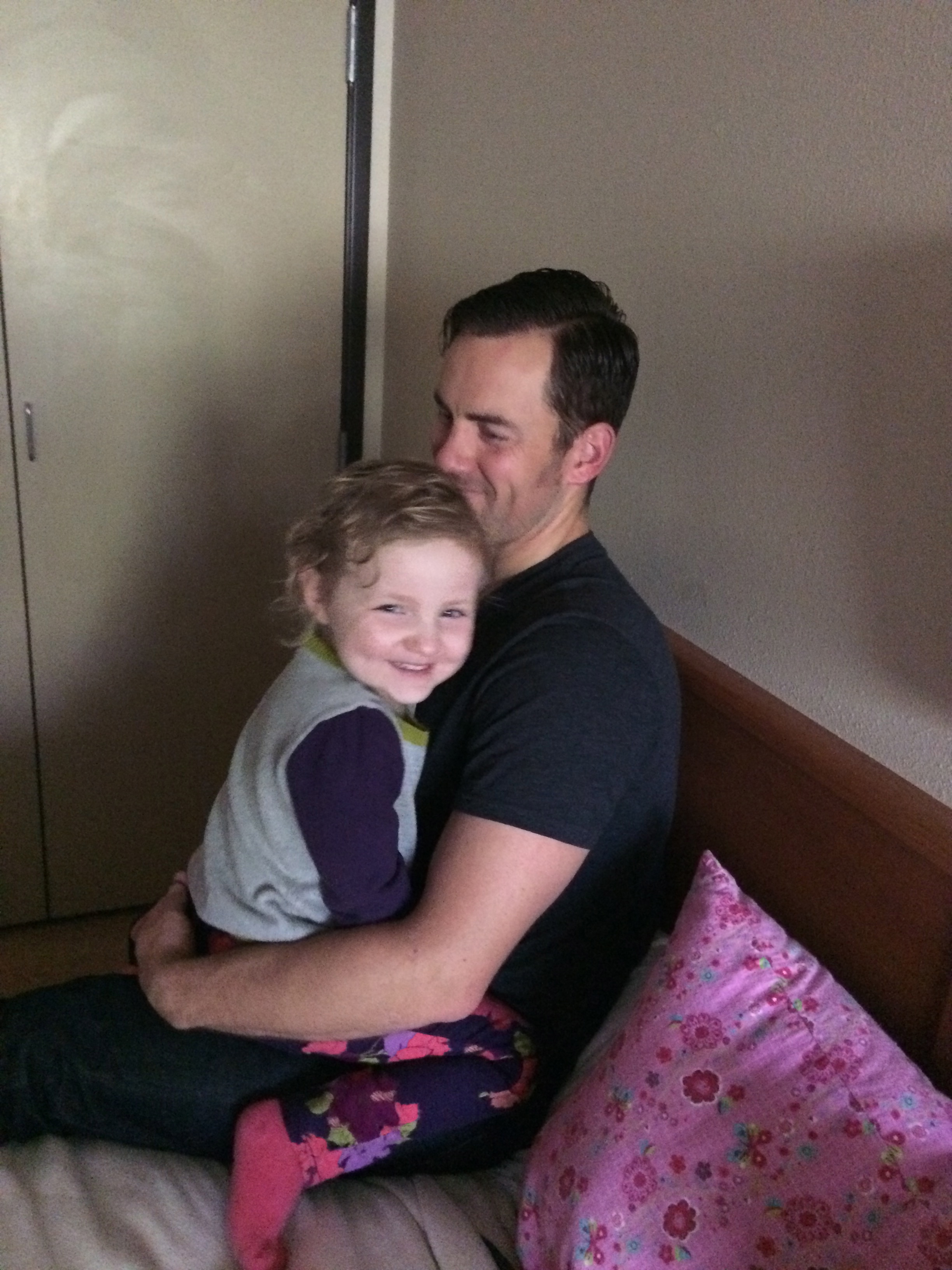
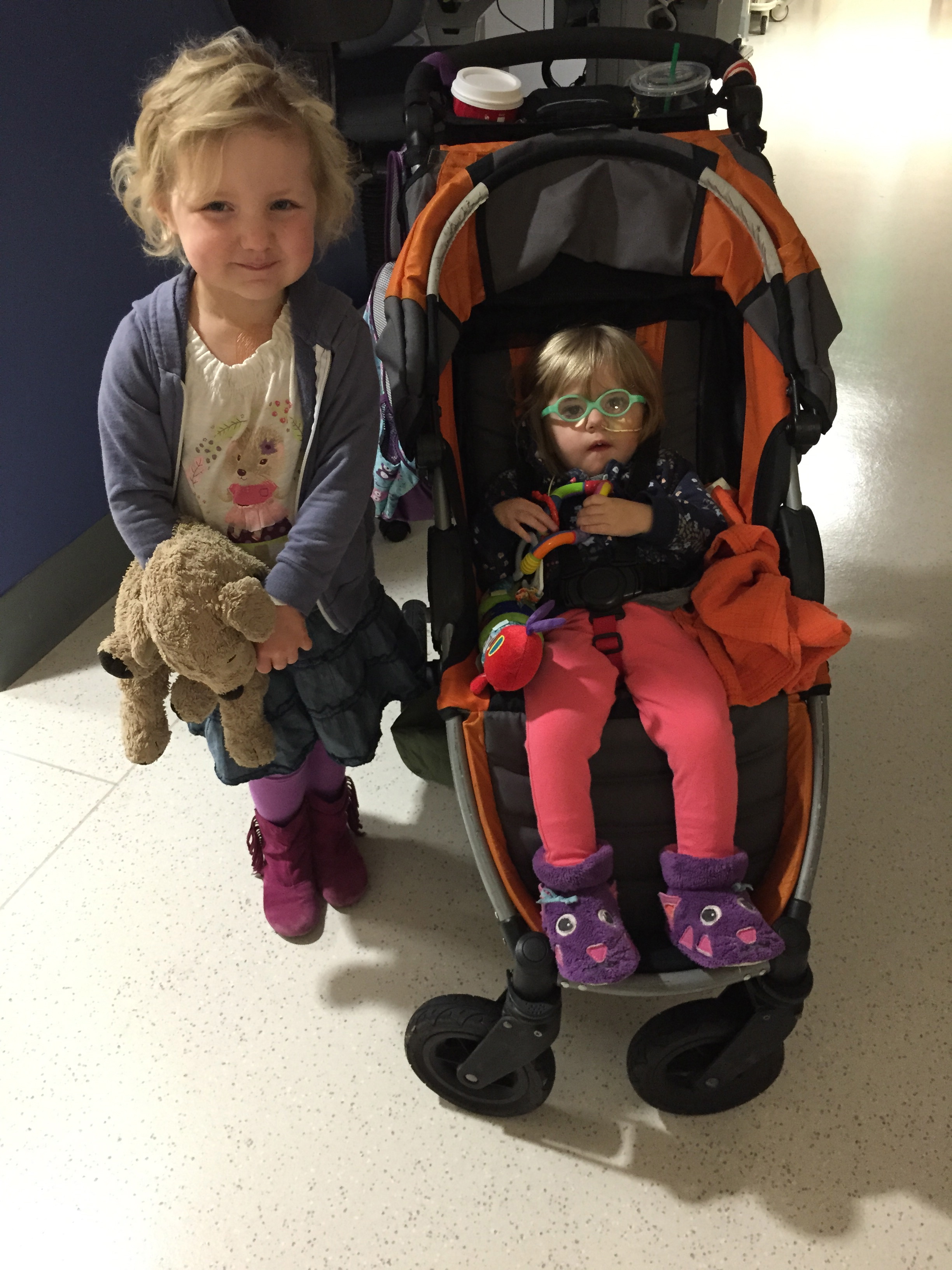
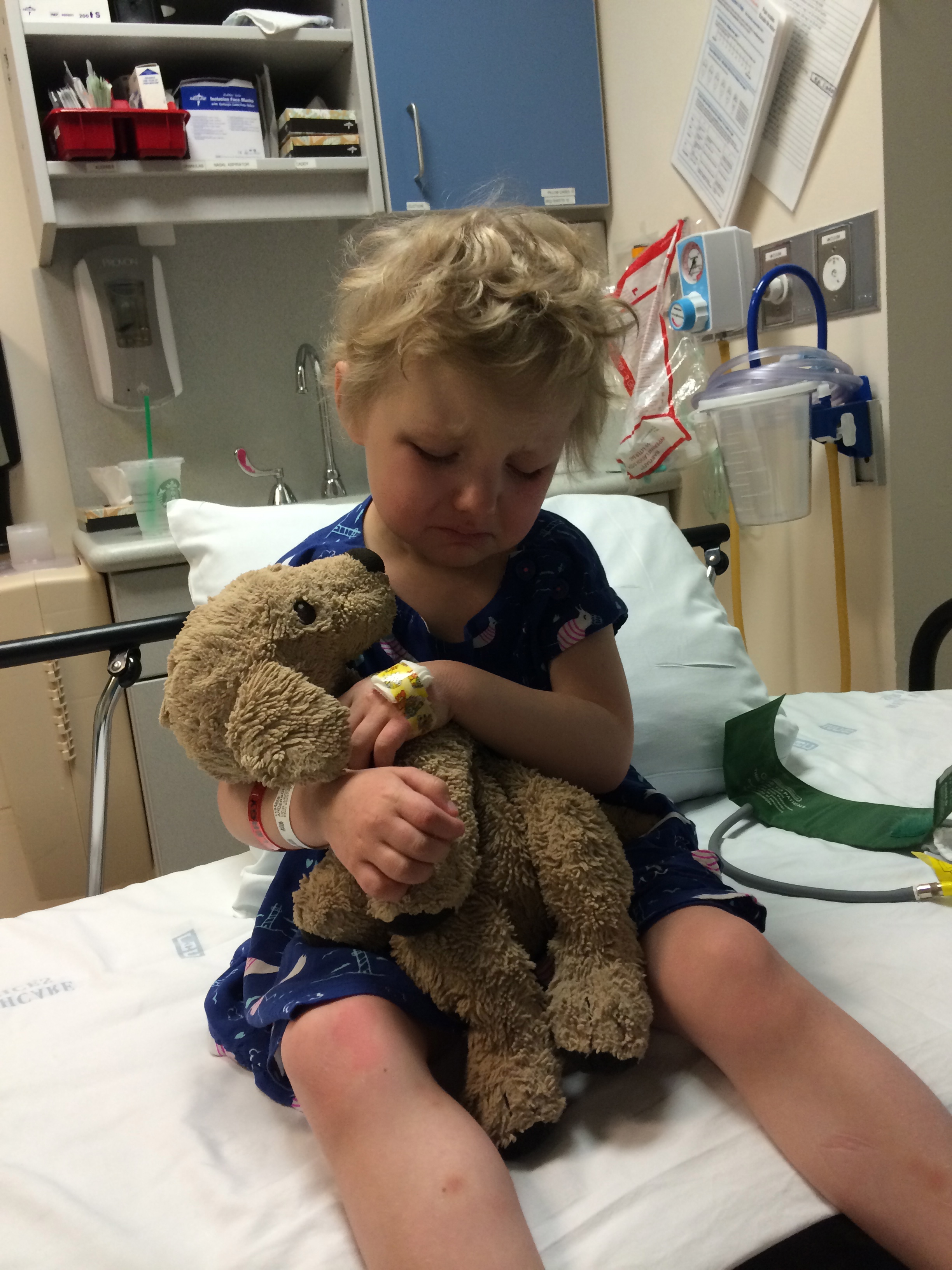
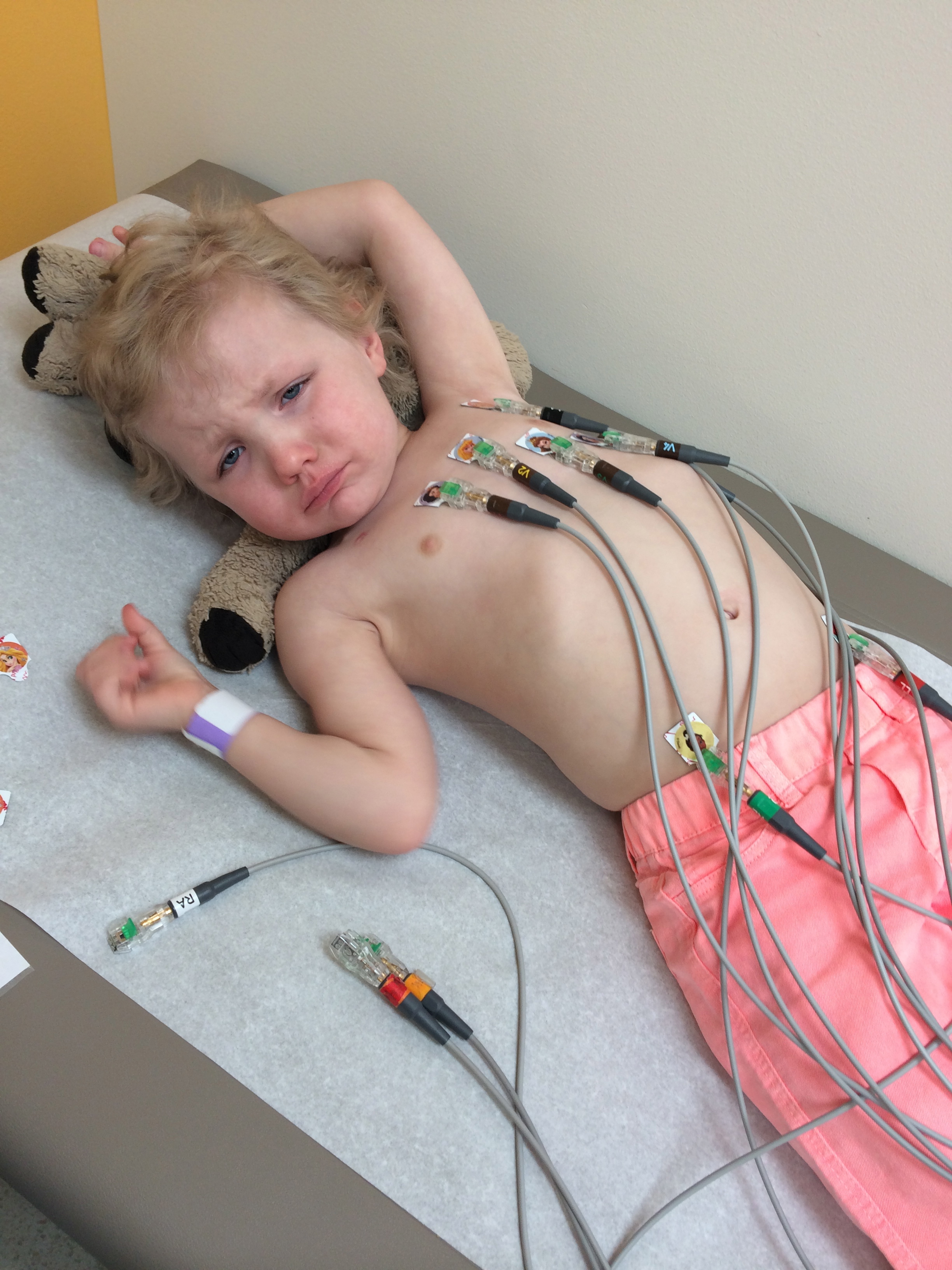
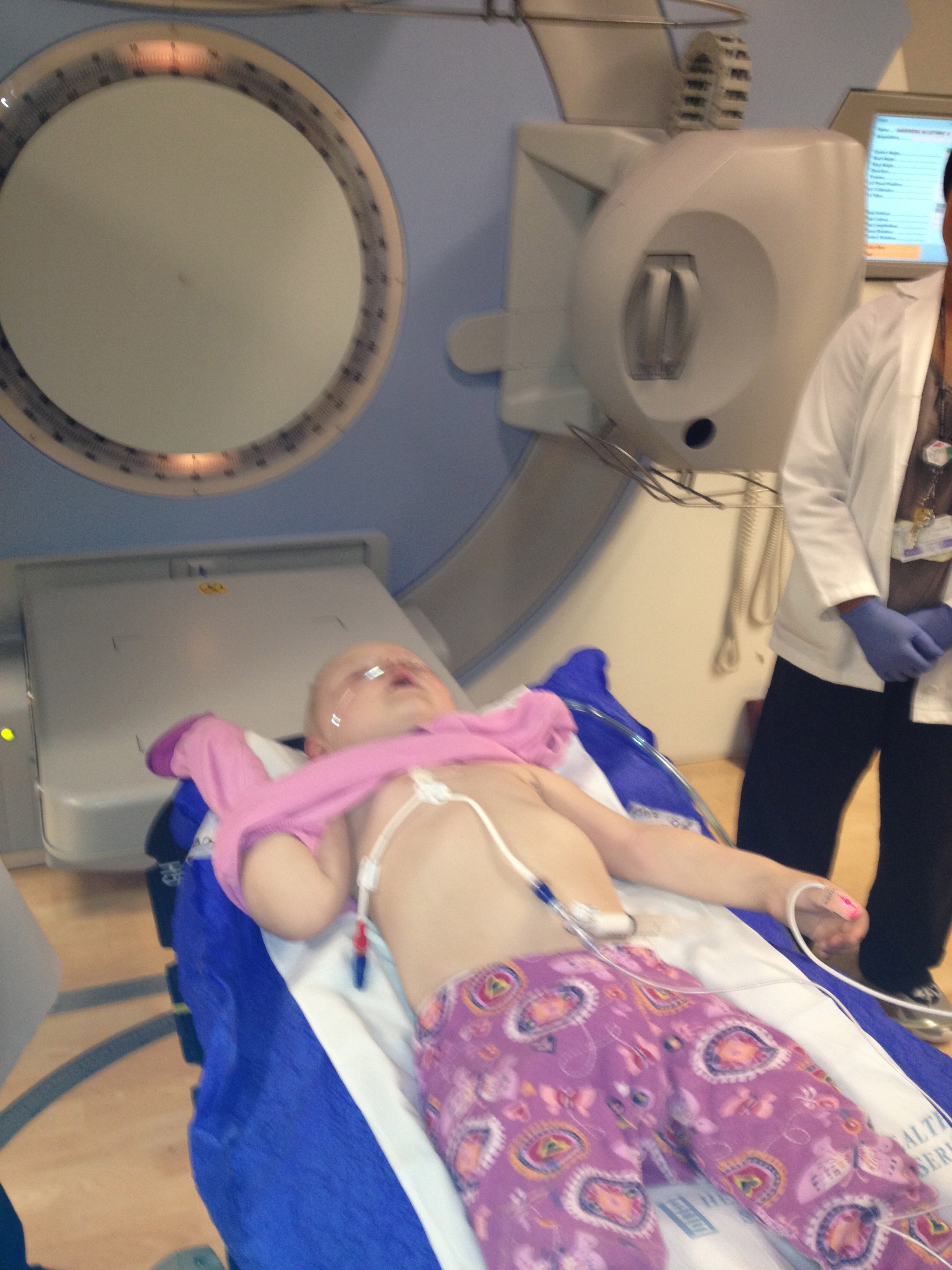
IMG_2628_2“I just feel like I could cry,” the nurse said dejectedly with arms slumped at her sides.  I totally knew what she meant.  All day I felt the strain of tears pressing against the back of my eyes, hot and insistent.  With one hand I held the X-ray plate, the other pressed up against her leg, the lead apron demanding the depression of my body.  Allistaire shook with pain and the multitudes of lines and agitating chunks of plastic surrounded her.  “I can’t do it,” she cried over and over.  “But you must, you must.”  A great sigh escaped my lips as the X-ray tech went to check if the picture was sufficient.  I hadn’t even known I had mistakenly allowed my weariness to see light until he said, “Almost done mom, just one more.”

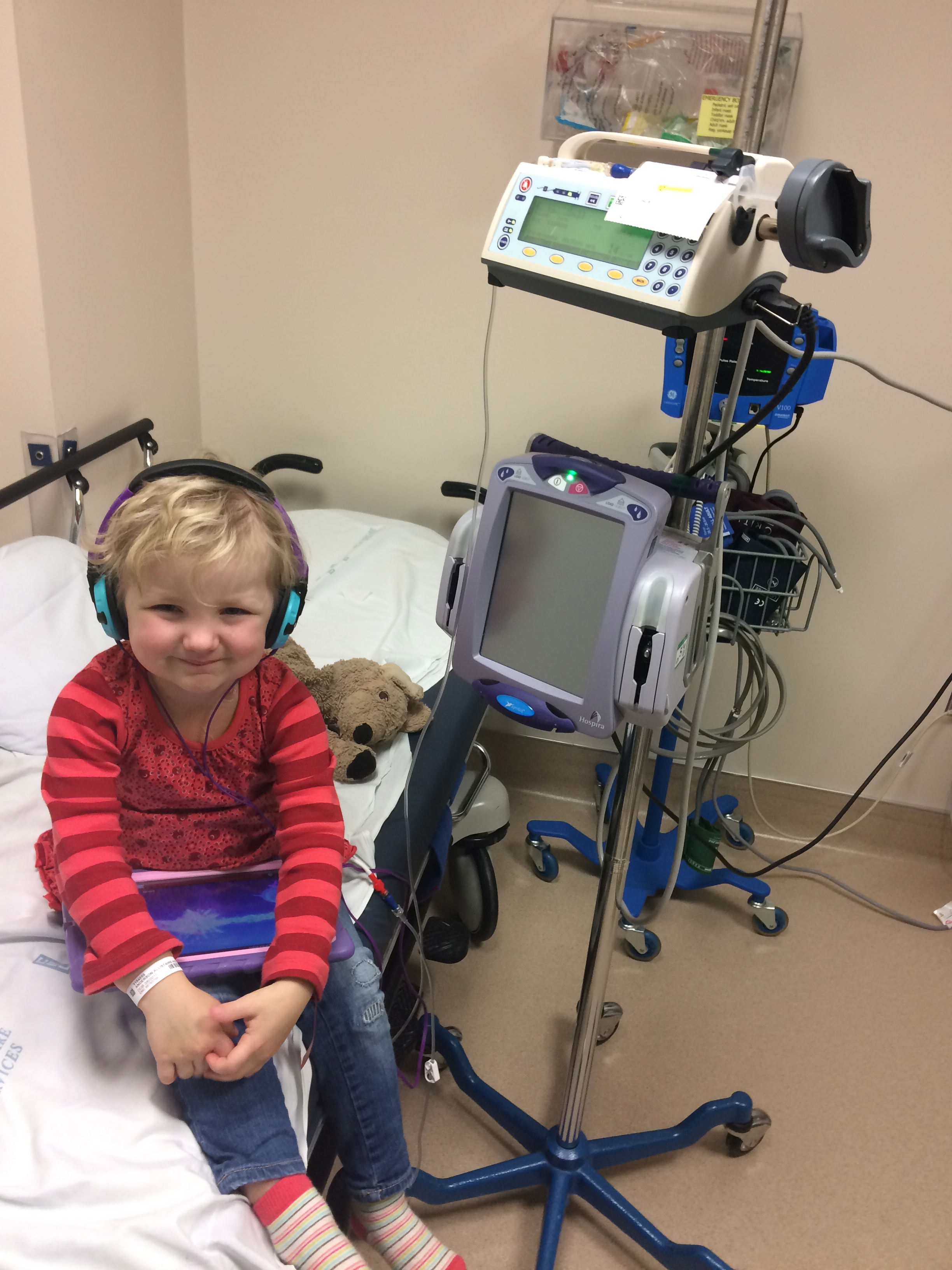
I push back, flattening the words of the podcast on how X-rays work.  Attend to the task at hand.  Disregard the weight of the lead.  Ignore the little lead heart-shaped shield they put over her ovaries for the chest X-ray and then remove for the 2 abdominal X-rays, every single day.  Forget that a CT is worth 250 X-rays.  You did not hear the suggestion to ask your dentist if that X-ray is really necessary.  Grip your child and ignore her protests, the beads of sweat on her brow and her labored breath because the pain won’t let up.  Now quick, onto the other tortures, lift her up this way and that, change the sheet and pull the measuring tape under her back to measure the distention.  Press her hands and toes looking for capillary refill.  She is exhausted.  So unremitting is the pain that she hardly sleeps and the turmoil in her gut breaks through multiple times an hour.  The pain meds are increased, boluses accumulating and new meds added.

It feels like we’re going backwards, like the past three days have never happened.  Her chest rises and falls rapidly, heaving.  Back on goes the Milrinone.  Up go the pain meds.  Increase the flow of the cannula.  Ease the burden on that left ventricle of her little heart, beating so hard with terror and with fight.  After two days of granulocytes, the neutrophils display their fury against the invader.  Their number has increased from zero to almost five thousand on Wednesday and after the second dose they are over seven thousand.  Who can understand their mysterious wisdom, how they know where to rush in haste to battle, to mend, but it shows in the incredible increase in pain and all night she has been feverish despite regular doses of Tylenol.  I guess this is the worse before the better.  It’s hard to watch and strange to be forced into the paradox of cheering and gratitude when everyone around wants to throw up their hands – what more can we do for her pain?  How high can we go with this dose?  What will calm her anxious fears?  We’re not even living it, just bystanders, constantly racking our brains to come up with what combination of meds in what doses and at what times will finally yield some peace for her.

Fourteen hours in my too-tight pants and socks that agitate the ever dry skin of my legs.  So irresistible is the scratching that streaks of blood line my ankles and calves.  I listen to the message on the phone in Ron Don about some package that has been there for days, waiting for me to pick it up, to respond to its little incessant presence.  But it is too late and in the morning I will rush again to the hospital to relieve Sten from his long night so that he can go nap for several hours.  I unbutton my pants that have pressed into my gut, unrelenting all day.  Another pair down?  Is that 3 or 4 pairs now that are too tight?  Another bit of myself goes skittering away.  No chance to exercise and some strange, frustrating need to eat.  How can I want to eat when all this is happening and all I do is sit in a room hour after hour for days?  I resist long but at last succumb to the warm comfort of the coffee cupped between my palms.  The hot liquid soothes as it goes down my throat, like a hand brushing slow across the forehead.  My hope is in this caffeine that perhaps somehow it can push back against that wall of fatigue that even recent good nights of sleep seem incapable of diminishing.

“I was wondering if it might be possible to make an exception and have James be allowed to show me how to pump up my bike tire?”  Before the ICU slammed out all other life, I had been attempting small steps to be more prepared for Obliteride.  Last years ride was fun enough to make me want to do it again, but so brutal that I knew I would be fool to not be better prepared.  My sweet mother-in-law generously has allowed me to borrow her bike, a fantastic bike made more so by its perfect orange frame.  What a strange color, orange. So bright, almost cheery, but with some sort of fiery force and determination.  It is a color to be reckoned with.  And out of the corner of my eye I would see it sitting there, locked safely in the corner of the bike racks.  I bought bike shoes I’ve been too afraid to use.  Little goals – take a picture of the pedals to buy the cleats that fit.  Check.  Get on the bike, oh but wait, I can see how to go one direction with the gears but not the other.  Thank goodness for google that yields the answer.  Tentatively, I ride, but not before I have walked my bike across the intersection.  I get to the Burke Gilman trail and feel slightly more at ease but anticipate the other cyclists speeding by yelling, “on your left!” And I try to make myself as slim as possible and hug the far right edge to give room.

Sitting on my bed later, I laugh at how tender my tail bone is. How in the world did I ever, ever get on a bike and ride 55 miles without having ridden in a whole year?  What a fool.  What an idiot.  But wow, who was that person, what carried her all those miles?  How did she say no, no to the aid car?  Was it not the pain of her own little girl?  The pain she has endured?  What is my pain, ever, ever, compared to hers?  I wrestle with my own heart, weeping and yet berating, what is my pain when I have been given so much?  She is here with me.  Who am I to let the tears come when I always see the grey eyes here and the blue eyes and the green brown eyes of moms whose hands now lay empty on their laps?  I have bounty upon bounty.  I have been given so much time that might not have been.  Such an array of armament has been brought to bear against the invader.  I have been offered unfathomable privilege to walk so far down this road of war.  How many mothers across this globe at this very moment weep and weep with limp child, eyes glazed?  But there they sit, the abundance and the ragged gaping loss.

I got on my bike last summer because I had so much to be thankful for.  I got on my bike last summer because my heart had been run through with the blade countless times.  There was ecstatic joy and severing sorrow.  I make little goals and devise little plans to get back on that bike, to acquaint my rear with the weight of my frame.  I stop the man from getting his own bike and ask, will you help me with these shoes?  I don’t understand how they clip in?  And he gives kindness to me a stranger, and he offers knowledge and extends encouragement.  Another man delays his ride home to help me figure out how to pump up the tire with the special pin, unlike the girthy simplicity of a mountain bike.  But then I flatten the tire utterly, inept at my attempt and sit feeling myself deflated despite my best efforts.  Her comes Seth again, I recognize his shoes and beard.  Again I entreat him to help me and he graciously pumps up my tire and instructs.  “What you need is the foot pump they have up in the bike cage, it would work so much better.” “Yes, but that is for employees only, ” I respond.

“Can you make an exception and allow James to help me learn how to pump up my tire?” I ask Jen in the Department of Transportation.  My hope is that they’ll allow James to teach me some basics that will help prepare me and give me a little more confidence out on the bike.  “Sorry, it’s just for staff.  It’s a liability issue.”  Before I know it, I’m gulping down barely audible sobs. The tears stream and I apologize, saying I have no idea why I’m having this response to something so small.  Before I know it I’m telling her there are some people who live, like actually live, in this building and are trapped here for long periods of time. It’s incredibly hard to find a way to exercise and all I want is some help to be able to ride my bike.  My spirit slumped and suddenly swamping waves of sorrow weigh heavy, an unconscious overlap of sorrow upon sorrow.  Perhaps it had something to do with the combination of hearing about the dangers of X-rays when I had only the day before been doing a bit of research on TBI (Total Body Irradiation), being prompted by seeing Dr. Ermoin, her radiology oncologist.  “Did you know that the Fred Hutch website says that TBI “is equivalent to being close to the epicenter of a nuclear bomb blast”?  “It does not,” he says alarmed.  “Oh yes it does.”  Only weeks before I finished reading the book, “Unbroken,” and vivid descriptions of the nuclear bomb dropped on Hiroshima.

Hiroshima.  My child.  Allistaire standing there in the gray devastation, the silent ripping of radiation particles colliding with her flesh, tearing at the fiber of her being, DNA sliced into ribbons.

I am powerless to stop it.

I wear the lead apron to protect my own flesh while her’s must simply accept again and again and again the devastation.

The waistline of my pants cut in and again I shift, trying to find comfort.  All I want is some help with my bike pump.  I am cut off from my home, my husband, my family.  I’m asking for help.  I’m ever in the position of being in need, but I’m willing to reveal my neediness.  I’m trying here people.  I grasp for help in folks passing by, going to their bikes.  Will you help me?  This person helps with figuring out how the bike shoes clip in.  That man helps with how to inflate my tires.  The first man helps again when I stand frustrated before the flattened tire despite attempt after attempt to get it pumped up.

Cancer makes you feel powerless.  Cancer isolates.  It’s just a tiny cell but somehow it seems to dominate everything.  All the forces of man are brought to bear against it, yet how it seems to ever overcome every effort.  You accept the destruction.  You say yes to the horror because you have no other choice.  You embrace, you praise, you rejoice in the weapons, pressing the collateral damage back, back to the periphery.  And the shrapnel of cancer slashes anyone in its proximity.  There is the slice of jobs lost.   There the bleeding hole of your relationship with your other child.  Time, seasons, swings of dark and light, leaves dead and leaves budding, friends living their lives and you just gone, gone.   Those too tight pants bring rage, bring silent tears you reprimand yourself for having.

All I want is to take my flesh in hand and have it yield to me.  All I want is to get my tire pumped up so I can get away from this building for an hour and breathe cold air and see something other than walls.  All I want is to fit in my clothes and not want to tear them off of me at the end of another day.  All I want is to fight back.  All I want is to ride my bike so this August, I can enjoy Obliteride.  All I want is to feel the power of my quad pressing down the pedal, speeding me away from this constricted, suffocating fight and closer to a cure.

I must give thanks to the little Hiroshima that will transpire in the basement of the University of Washington Hospital within those lead lined walls and door.  I must give thanks to the poison that decimates my child’s immune system and has left her vulnerable to these ravaging bacteria.  I give thanks because these are the forces that have taken years to understand and develop.  I fall on my knees in gratitude for the hundred of thousands of hours of research scientists endeavoring to unravel the power of cancer.  I give thanks for three years of life for Allistaire that could have never been were it not for cancer research.

I mourn and I wail because of that most wretched Hiroshima unleashed on my child, that killer not only of cancer cells, but brain and bone and ovary and pituitary.  I fall on my knees in grief for the poison that distorts the DNA of her cells and heart and skin.

I grieve years lost and rejoice in years gained.  For they are one in the same.

Obliteride is a grieving and Obliteride is a rejoicing.  It is one in the same.

This August, I will once again have the joy and privilege to participate in Obliteride which is a bike ride to raise funds for Fred Hutchinson Cancer Research Center.  One hundred percent of funds raised go directly to cancer research.

I now know how to pump up my tire.  Soon I will know how to use my bike shoes.  My bum is already getting acclimated.  As I trudge up and down, up and down the eight flights of stairs in the Forrest stairwell morning after morning, as I ride down the trail, as I feel the burn of muscles being pushed to do more, to go further, I smile.  I will one day fit into my pants again.  More importantly, one day there will be no need for Hiroshimas or poison.  One day cancer research will have found the way to fully harness the immune system and stop cancer in its tracks, without the collateral damage.  Maybe one day we won’t need a cure, because we will have found how to prevent cancer.

I’m going to keep getting on my bike.  I’m going to get on my bike in anticipation of this summer’s Obliteride.  I am going to get on that bike every single year the Lord gives me life and there are muscles that can move.  For I have much to be thankful for.  I have much to grieve.

How about you?  Where has the shrapnel of cancer lacerated your life?  Where has cancer stolen from you and caused your heart to grieve?  Where has cancer unexpectedly given you so much rejoicing and thanks that you never knew before?

One of my favorite quotes is this:

“It is the greatest of all mistakes to do nothing when you can only do little.  Do what you can.”

If you would like to support me in raising money to fund cancer research click HERE

Help me OBLITERATE cancer!!!!


If you want to join our team for this summer’s Obliteride, we’d love it!  Emily, Jo and Lysen have once again committed to another year.  Leave a comment on the blog if you’d like to join our team and I will get right back to you.IMG_0481

Juicy

Standard

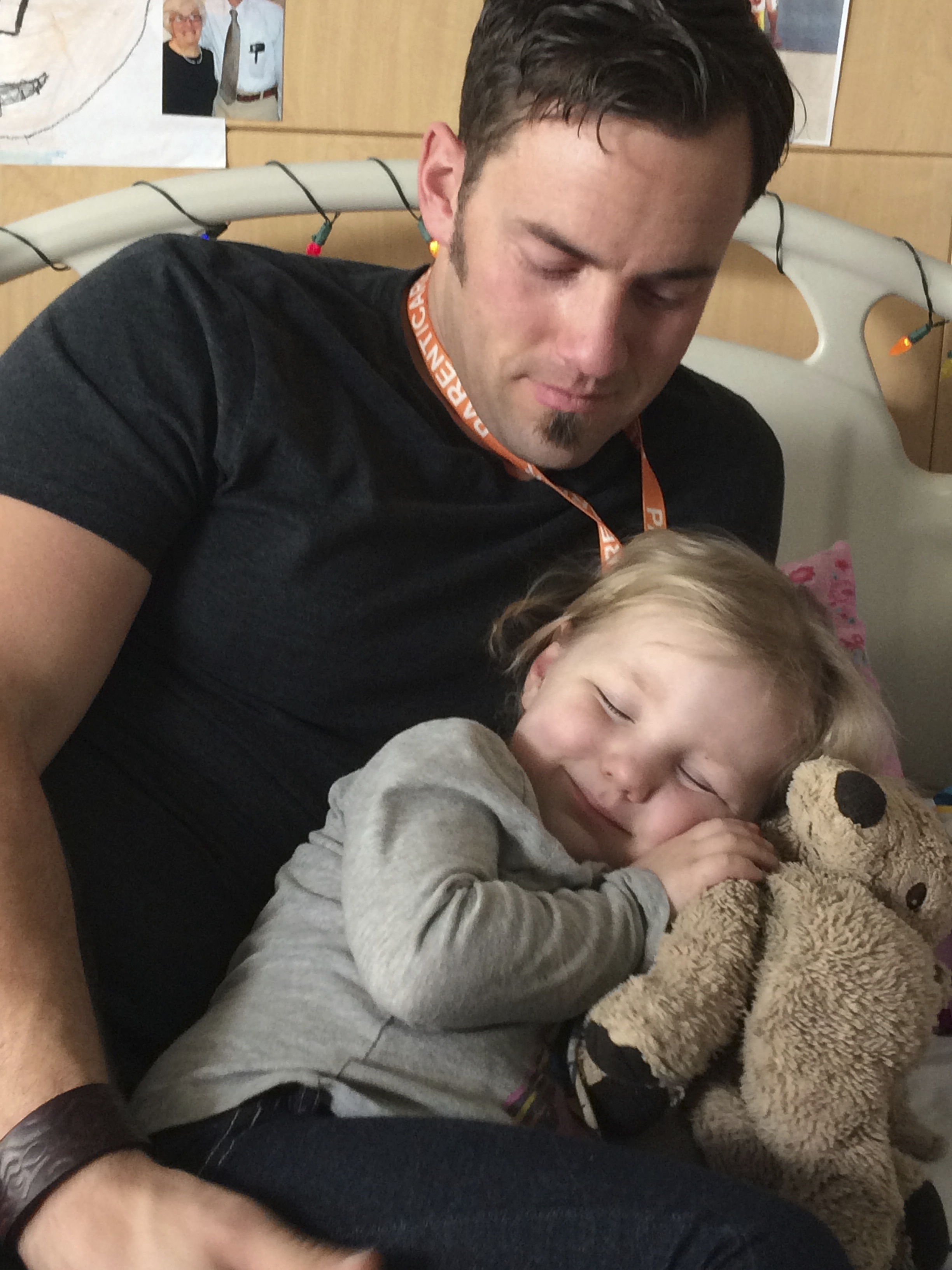
IMG_2153Ours is a sanitized fight.  I have only ever seen two insects on the Unit.  One would never know there was weather outside were it not for the horizontal planes of glass affixed to the side of the new building to contrast the vertical slices of blue, orange and green glass.  The rain hits the horizontal slabs, reminding the inside dweller that life does indeed exist out of these confines.  How I treasure those horizontal planes. Ours is a tedious, slow fight of absurd wealth.  The amount of financial, material, technological and human resources brought to fight for Allistaire’s life is staggering.  The light is bright with cheery images on the walls and flashes of exuberant color.  Countless groups come to the hospital and to Ron Don to make the season joyous.  Gifts flow in and in and in.  Everywhere smiling faces, time given to compassionate conversations and cheering us on and rooting for Allistaire.  Everywhere love and support.  Ours is a fight with so many allies.

In anticipation of the movie, “Unbroken,” coming out, I am determined to read the book first.  Much to my chagrin, I have not read much of history and this account of World War II in the Pacific gives me a much enhanced admiration and appreciation for our veterans.  How they faced the horrors common to war is awe-inspiring.  Their fight was poorly financed, poorly equipped and fraught with terrors I cannot begin to grasp – exploding flesh from countless weapons, disease, lack of medical care, sharks, exposure, starvation, torture.  In the same way that we press forward, unwilling to loosen our grip on life, they endured, they strove to hold onto life.  When Allistaire was first diagnosed, I kept thinking, if I was a Haitian mother, I would simply have a dead child.  There would be no fight.  There would simply be a swift succumbing to wretched disease.  So it has been throughout history and so it is in countless stories across this earth at this very moment – fights for life – lives cherished and infinitely valuable.

I went to bed Thursday night with the thought that we have been given SO much.  It is privilege to even have the opportunity to fight alongside Allistaire for her life.  Few have been given so much with which to battle, to persevere.  Who are we to have been so blessed?  The thought of what people must endure on this earth is utterly heartbreaking.  This fight tears constantly at my heart and yet, it is gift.  It could be so very different.  I went to bed more at rest in my spirit.  I woke less and still woke with heightened anticipation, but not terror.  I know the Lord is good and He sees the whole expanse while my sight is limited to a ridiculous degree.  Who am I to say what is best and thus what tomorrow should bring?  I keep handing her over to Him, entrusting her to Him, entrusting my heart and my life to Him.  Do as you please Lord.  You are my whole heart and it swells with longing for you Lord.  I live a dual anticipation – what will come to pass with Allistaire and looking for what the Lord will do.  The question of “why,” has never dominated my thoughts.  The earth and all that is in it is broken and it longs with eager anticipation for the coming of Christ to fulfill all His promises and restore and redeem.  The question of why rests far more on, “Oh Lord, why have you brought this wild, wringing sorrow into my life?  You are not an arbitrary God.  You are a sovereign, beautiful God, so what is your good intention for this road you are having me walk?  Why us, why now, why here?  Who will you put in our path?  How can I walk these halls and these days with face radiant because I HAVE seen you?!”  I don’t believe in accident.  I ask, “why,” because I am on the lookout for the beauty of what the Lord will raise up out of these days.

I actually experienced rest Thursday night and woke Friday once again in prayer, once again asking the Lord to orient my heart to Him – that He would fill my vision.  He has provided so abundantly, will I curse Him now if things do not go as I desire?  He is not a fickle God.  Is He not still the same good God when blasts appear on the lab sheet, when Flow Cytometry reveals an ugly diseased marrow?  I rose from my surprisingly comfortable couch bed to go and find our nurse, Nate, to discover what the Lord gave this day.  Allistaire’s ANC was 230 and there were zero blasts.  This meant a green light for her bone marrow test and ecstatic joy.  My joy was compounded when the doctor who did Allistaire’s bone marrow brought out a bright red, juicy sample of bone marrow to show me and tell me how good things felt in there, how simply good the sample looked.  On Friday they did a bi-lateral biopsy and aspirate, meaning they took sample from both hips in order to ensure sufficient sample given how hard it was to achieve last time due to the fibrosis.  Friday’s sample showed a changed marrow.  So, no blasts, rising ANC, platelets and hematocrit, a juicy fabulous sample of her marrow, lots of energy and no pain – as Dr. Gardner said, we have “guarded optimism.”

After I put Allistaire down Friday for her nap, I went to Ron Don and laid down, intending to read, “Unbroken.”  With lights of the room blazing around me I allowed myself to succumb to sleep.  Three naps in one week – what in the world?  A year could go by and I would not have typically had a nap.  Naps don’t work for me.  But an incredible exhaustion settled me flat on the bed and I dozed.  Perhaps I should be packing clothes for the next few days, but who could know which way the next few days would twist and turn.  I met with Dr. Gardner on Thursday afternoon to discuss three things: what was necessary to move forward with transplant, Denver and discharge.

As Allistaire’s ANC rose over the past week, the team started talking about discharge.  One might think that I should be excited about getting booted from the hospital but in fact “out there,” is a terrifying world I’m not excited to take Allistaire into – especially not now.  The docs pointed out that she has an ANC now which means she has a few lymphocytes (white blood cells) to fight illness.  Yeah, but perfectly healthy people with astronomical ANCs are getting taken down left and right with the flu and various other horrid colds and such, not to mention the Hand, food and mouth disease and Whooping cough going around Montana that could carry itself in the backs of our family.  Now more than ever, it is utterly essential to protect Allistaire from getting sick.  If the chemo has miraculously succeeded in getting her disease knocked down enough to move forward with transplant, then a very precise timing begins where two very separate lives must intersect at exactly the right moment.  The “conditioning,” (chemo and radiation), for transplant is timed in alignment with the donor prepping for the removal of their stem cells.  Cells are living organisms and can only survive so long outside the body and as conditioning begins for Allistaire, the process of permanently destroying her bone marrow has begun.  So, it is imperative that nothing stands in Allistaire’s way of walking each carefully planned step forward to transplant if we are given that option.  Something like RSV (a respiratory virus) is actually fatal in transplant.  She won’t have time to “get over being sick.”  The thought of leaving the hospital means she and I will be trapped alone in our room at Ron Don.  She can’t be in the communal areas and in order to get food I would have to take her with me to the grocery store which is a hot-house of hacking, sick people and kids.  Our best option is to go very early in the morning or late at night when we have a chance at steering clear of the sickos.

Then there was the issue of Denver.  So the bummer news is that the initial findings of the study, in the adult patients anyways, is not too impressive.  Only about 25% had a good response.  As Dr. Tarlock later told me, these aren’t such poor statistics for a single agent and likely this drug will be combined with other therapies in the future to have a far greater effect.  The truth is too, that this trial is Phase One, meaning they are only testing for safety, not efficacy.  The point being, it doesn’t seem worth it to send Allistaire to another state, another hospital, another group of doctors for a drug that isn’t a likely hit for her – unless there are no other options of course.  Dr. Gardner was going to see if she could contact the principal investigator and get a sense of how the pediatric patients were responding, as it could be quite different from in the adults.

By the way, here is yet another plug for pediatric cancer research – did you know that the NCI (National Cancer Institute) only gives 3-4% of its annual budget to funding pediatric cancer research specifically?  Here’s the problem, far fewer children get cancer than adults so it is not in the pharmaceutical companies financial interest to fund research to treat pediatric cancer.  So really, kids only get what eventually might trickle down to them from cancer research in adults which means much more time passes before there are any breakthroughs for kids with cancer.  Additionally, there are a number of cancers that only children get, like neuroblastoma.  Even AML, which is the most common form of adult leukemia, most likely has different origins and characteristics for children than in adults.  When a child is treated for cancer, their body is rapidly growing and every organ from the heart to the liver and brain are being poisoned from the chemotherapy and radiation.  Chemo targets the fast growing cancer cells.  In kids, all the cells are growing far more rapidly than in adults which means their healthy cells are much more vulnerable to the onslaught of chemo and radiation.  When an adult is cured from cancer, their life has been extended by and average of 15 years.  When a child is cured from cancer, their life has been extended by an average of 71 years.  So if the NCI won’t fund pediatric cancer research and the pharmaceutical companies have no incentive to do so, it means the real hope for children with cancer rests with the private donor.  Allistaire has benefited directly and significantly from research at Fred Hutch which treats adults as well and I will continue to root for them and seek to raise money for what they are doing, but there is also a place for giving directly to childhood cancer research.

Okay, back to the most significant issue at hand – what reality will enable Allistaire to move forward with transplant?  What must be true from the results of the bone marrow aspirate and PET/CT?  Dr. Gardner said the most important piece is that the disease in her marrow must be quite low.  The less there is in her marrow, the more likely the transplant is to succeed.  So while the transplant allows the patient to not be in remission, it is still far better that they are.  She said that if the pathologist looks at Allistaire’s sample under the microscope and she is morphological remission which is defined as 5% or less disease (this is the lowest detectable amount with the microscope), then she will be in good shape to move forward with transplant.  Of course there is also the issue of her chloromas (locations of solid leukemia).  One would presume that if the chemo worked in her marrow, it would do the same in the chloromas but apparently tumors have their own micro environments that can allow and promote cancer cell growth that doesn’t take place outside of them.  Only the PET/CT will tell the truth about what’s going on inside, but so far she has not had any pain which is a good sign.  Neither Dr. Gardner nor Dr. Bleakley are super concerned with the chloromas simply because they can be treated with focal radiation if necessary.  Of course this is not optimal as every part of the body that is exposed to radiation is more prone to develop cancer in the future and can be damaged or deformed.  I am sure that an increase in the number or size of the chloromas would require quite a discussion, even if her marrow was in good shape.

I left my time with Dr. Gardner with the plan that she would see what she could find out from Denver, and that if her marrow looked good, we would be discharged from the hospital and if not, we would stay in.  So what’s the point of packing I thought.  I lay in a flattened, utterly still state.  The phone rang with that attention grabbing number ever emblazoned into my brain: (206) 987-2000.  My heart jumps every single time that number shows up on my phone.  Even when all has been well that number gets my heart thumping and dampness of the palm.  It was Dr. Shoeback, the attending doctor at Children’s.  “The pathologist can see no cancer cells in Allistaire’s sample.”  WHAT?  Utter ELATION!!!!!!!!  I could not believe my ears!  Allistaire is in morphological remission and only the possibility of a horrible PET/CT stands in her way of moving forward with transplant.  After the exhausting torture of her last relapse, I could not have imaged this being possible.  But it worked!!!!!!  On Monday we should have results back from Flow Cytometry, but that will only give us a number below 5% and while it would be awesome if it was zero, it doesn’t need to be any less than 5% to be given the open door to transplant.

On Monday at 1:15pm, Allistaire will have her PET/CT scan and by the end of the day, I should hear from Dr. Gardner with the results.  Of course a plan can’t really be formulated until all the data is in, but the AML docs and Dr. Gardner are discussing with Dr. Bleakley what would be the best plan for “bridge chemo.”  It is necessary to have some form of treatment between the end of this round of chemo and conditioning chemo because you ethically can’t get the donor moving forward with their steps until you know you really can have a transplant.  By the way, while Allistaire has no U.S. donor, Dr. Bleakley is trying her best to exhaust all possible options for Allistaire.  She is in contact with the German version of the FDA to get approval on their end to get a consent process with the overseas donor to manipulate the T-cells.  I think the idea is that this is an additional step taken with the donor’s cells and because the donor’s cells are technically part of the donor or owned by the donor, they have to give consent.  If you want a super interesting read on this topic, check out, “The Immortal Life of Henrietta Lacks.”  If approval is given through the German system, Dr. Bleakley can then seek out approval from the FDA.  Even if all this approval goes through, there is still the issue of the timing and age of the cells given the additional time that would be required to process the cells in Seattle.  If the donor is from a “major center,” in the German system, this increases the likelihood that the quality and timing of the cells could work.  Dr. Bleakley says that ultimately it will be up for Sten and I to decide what we want to do.  It’s a gamble really.  The conditioning chemo for the trial transplant and the standard transplant are different.  The donor cells could arrive from overseas and it be determined that they are not in good enough condition to be processed and take out the naive T-cells.  In this case only the minimal processing that always occurs with donor cells would take place and Allistaire would get the transfusion of donor cells as is.  There is a lot to consider, if even we end up having that choice to make.  In the mean time, Allistaire will need some chemo to keep the bad guys down.  This could either be another round of the DMEC (Decitabine, Mitoxantrone, Etoposide, Cytarabine) which she just had – in the clinical trial it has been given in one to three courses.  Because her heart remains in good shape, this would be an option.  Additionally, Decitabine can become even more effective over multiple courses in the same way that Azacitadine does, which she had post-transplant last time.  Another option would be Decitabine alone.  Lots of brainstorming amongst the docs is necessary.

I can hardly believe it.  I can hardly take it in.  I cannot stop smiling!!!!!  My girl has been given one more open door.  Every day of this journey feels like walking around a blind corner.  There is absolutely no way to predict what the next day will bring.  Often the entire trajectory of your world can shift from morning to night.  The wind blows, the seas rage and toss and yet the north star is unmoving.  I keep my eyes fixed on Christ, my one sure hold.  Tomorrow morning we rise to a new day.  I have no idea what will be known when I lay down to sleep Monday night.  What if this whole thing, this crazy journey is just so that I would meet Debbie today in the rug aisle in Target?  What if all these years of highs and dark lows are so that I could tell her, Debbie, my hope is in God!  My hope is in God!  Not that He will save Allistaire, though I have joyous confidence that He can overcome the most hideous of cancer cells, but that this whole crazy life and world are His and He will accomplish the beauty of His will which is more magnificent and glorious than we could ever, ever imagine.  His promises are sure footings.  Debbie, your hope can be in God, in Christ the Savior who was born to bring peace and goodwill to all men!  Oh let the whole earth, the whole wondrous earth sing His praises, may every cell of my flesh rise up and strain to declare His love, His beauty, His overcoming power to redeem and raise the dead, the dead heart, the dead flesh.  He is coming, He is coming and I am on the lookout!

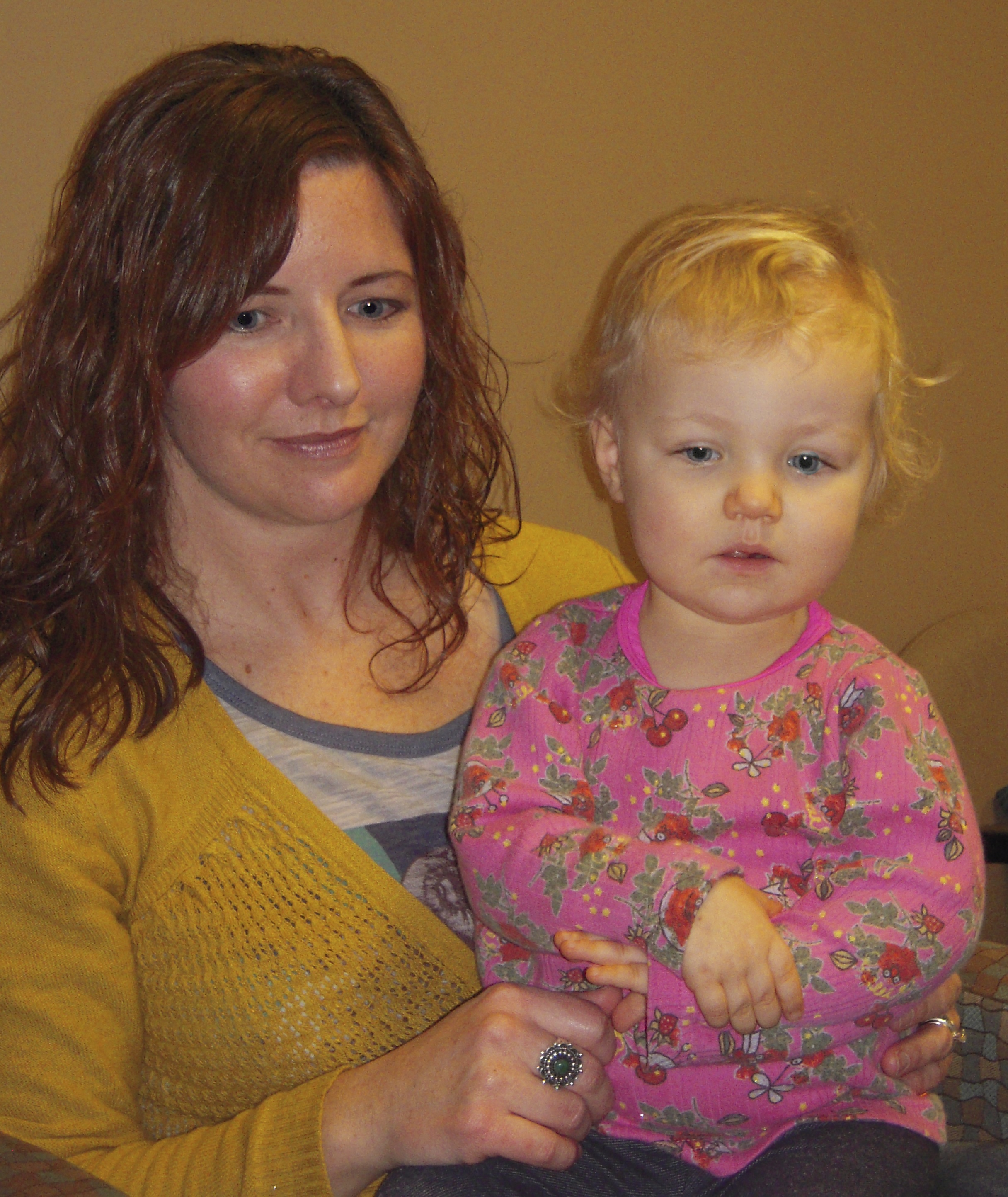
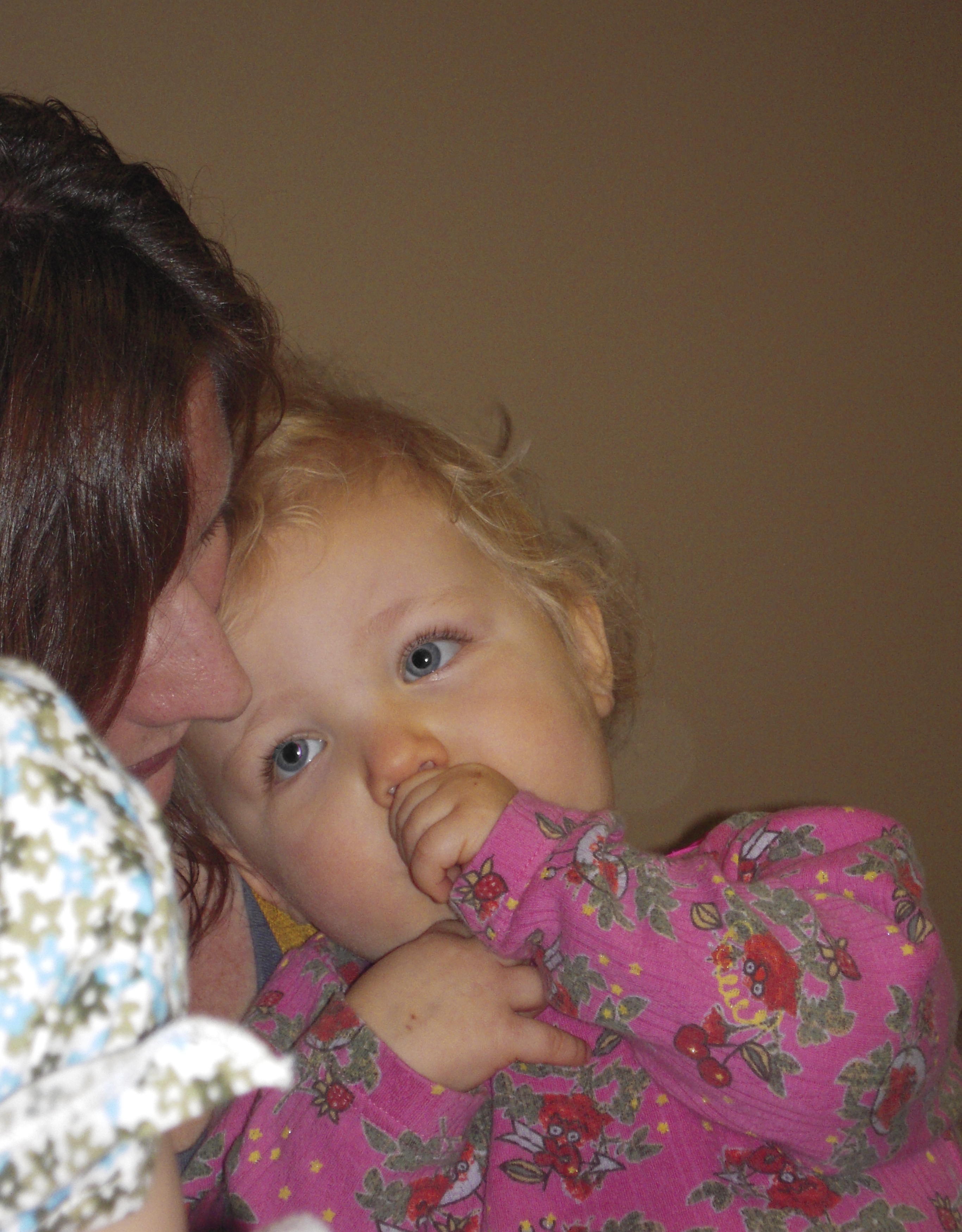
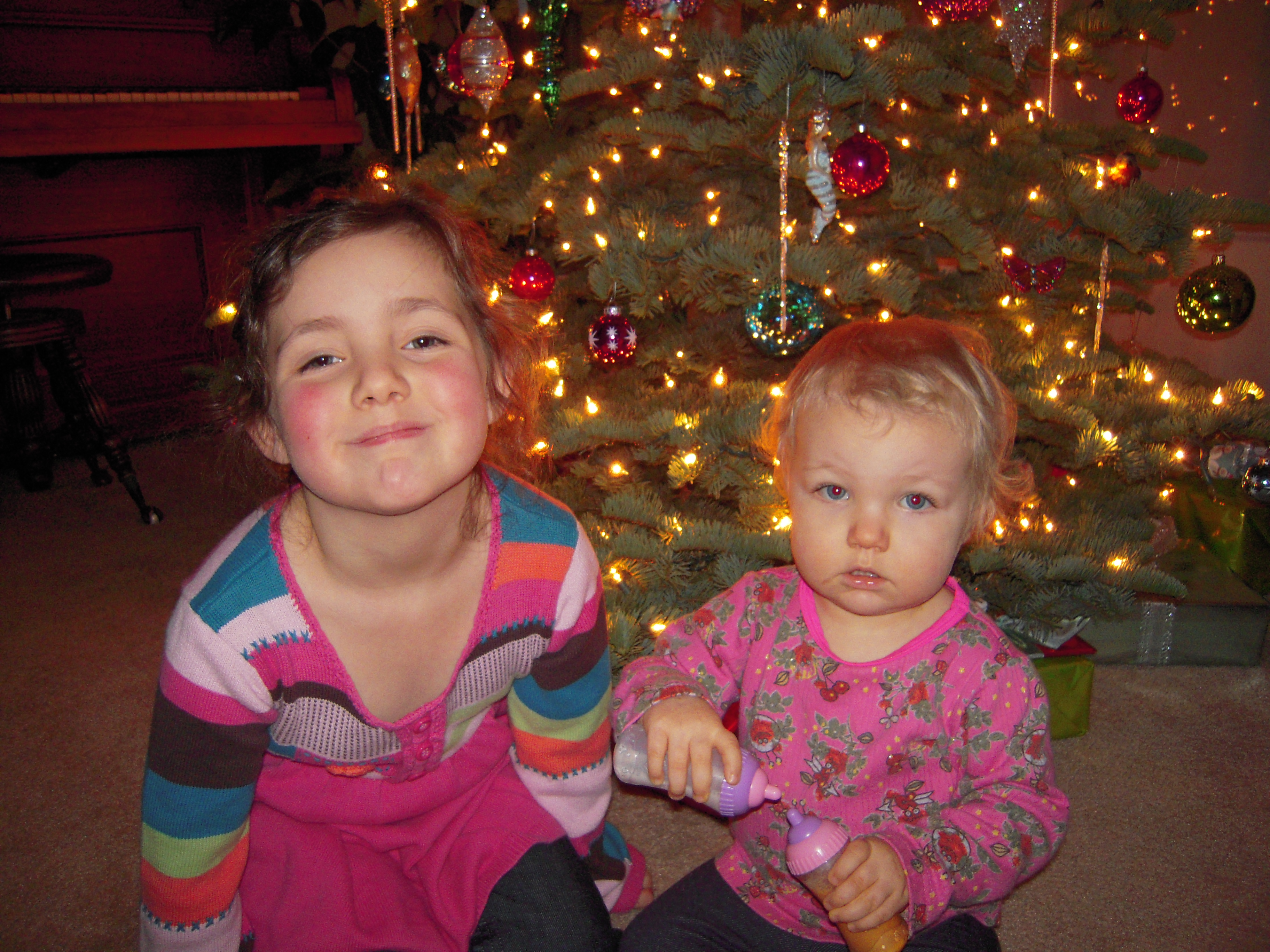
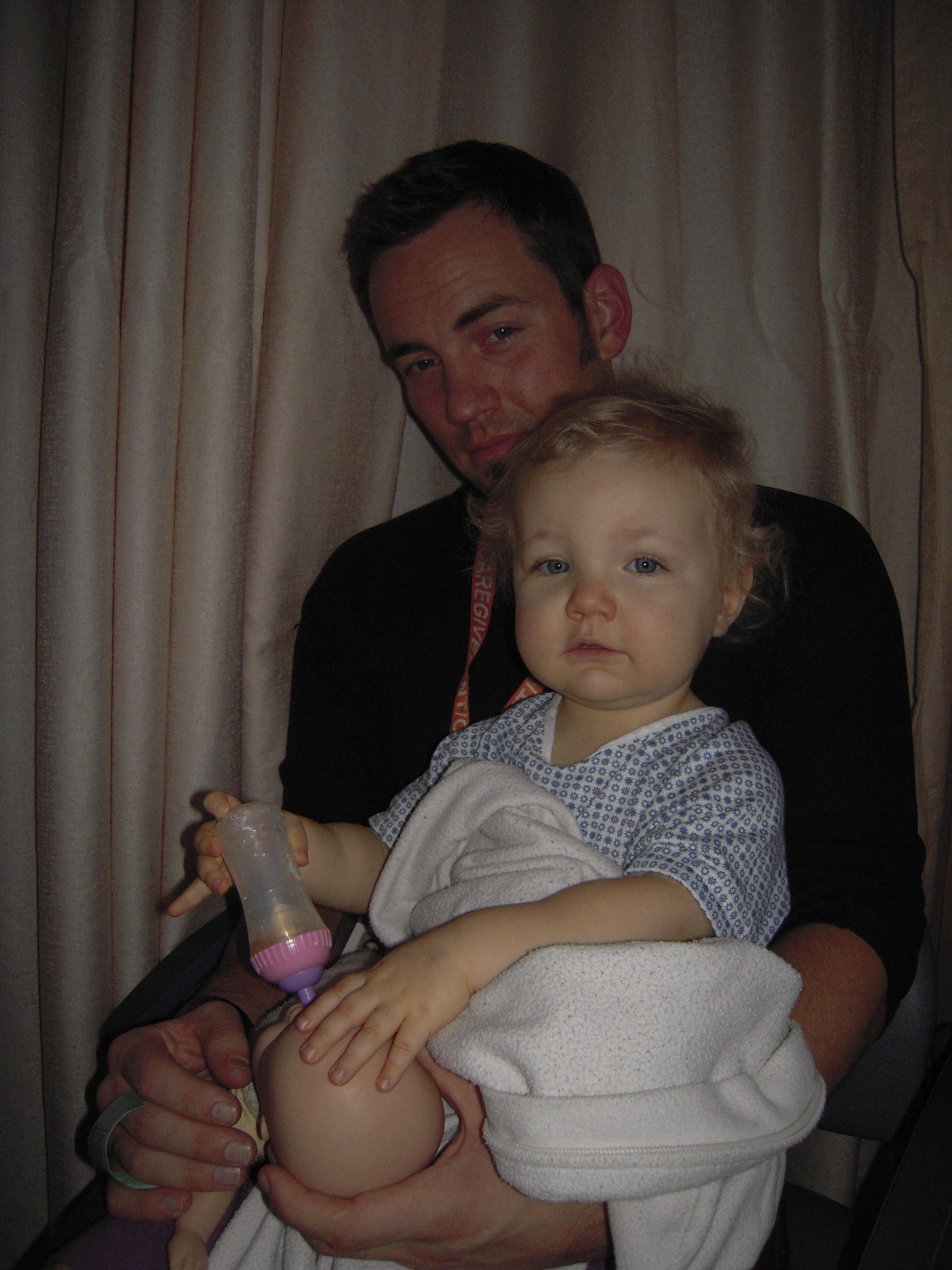
(The top picture is of the vial of her bone marrow aspirate and the the tiny bit of bone is the biopsy.  I’ve included at the end a number of pics from three years ago – always wild to see some perspective on our journey)IMG_2149 IMG_2154 IMG_2155 IMG_2159 IMG_2160 IMG_2161 IMG_2164 IMG_2173 IMG_2181Allistaire with Papa sisters and cousins 1 Christmas Family Cancer Fears Me DSCN4804 DSCN4805 DSCN4806

A Thousand Barricades

Standard

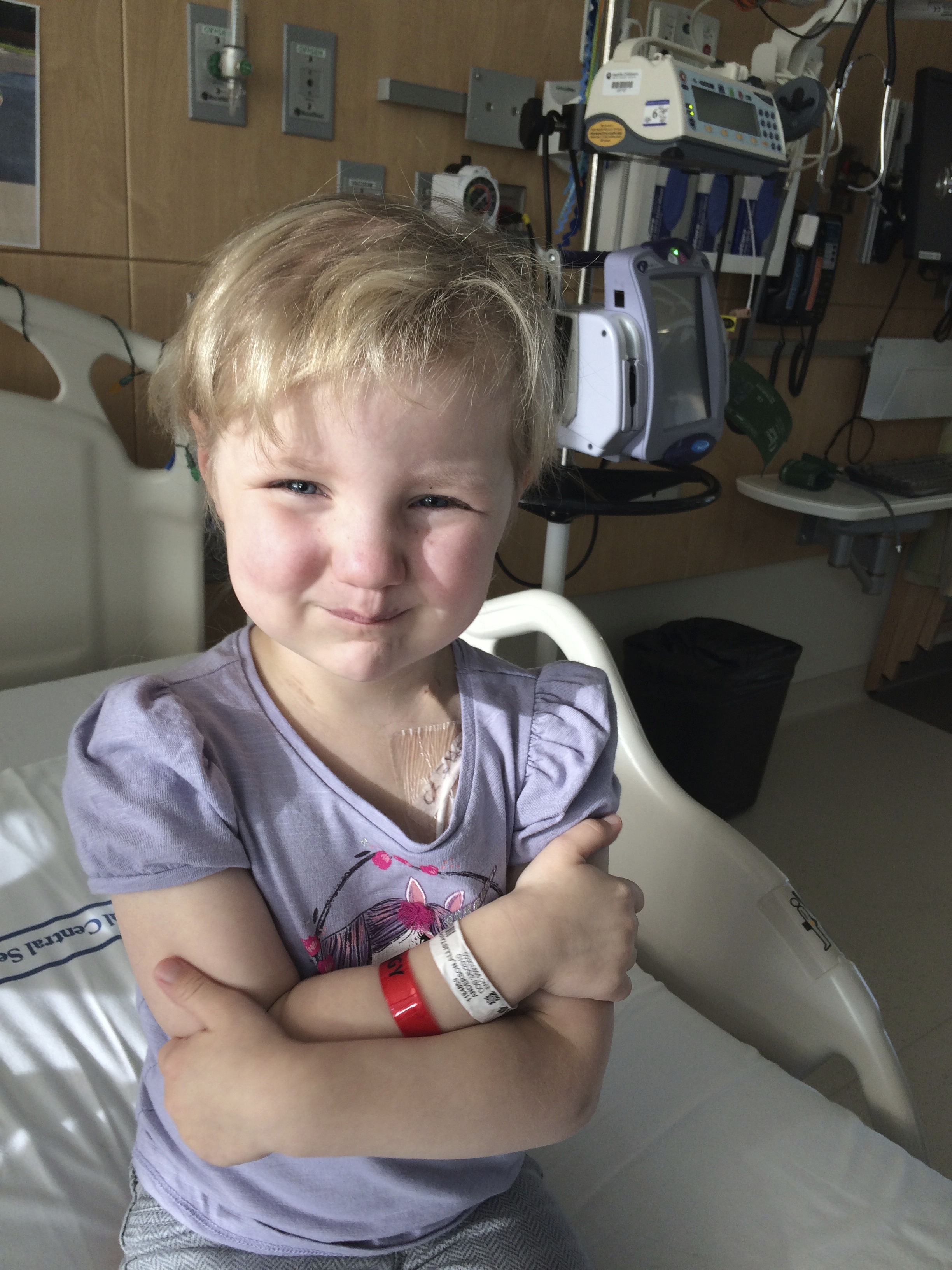
IMG_1926Written yesterday:

Your body rebels and declares no one should need rise before 4 am, and yet out there in the dark crisp cold of night, yet early morn, you relish the clarity of stars and moon and blue light on snow as though you have snuck in and been witness to that which is the earth’s own private beauty, beauty sown in the hours that only animals inhabit.  My lungs stretched and with wide-spread arms, pulled in freshest air and with glee, took in the tiny twinkle of stars, each one called out by name, by my God, by my Father.  And with deep breath, I asked again that the Lord would hear my cry, that He would hold me up in the day and days to come.  I thought back to the unexpected conversation with Nate about sorrow, about loss, about fainting hearts and my words that yearned to encourage that it is good to be broken, to be at loss, to know neediness because it is the way into knowing God and mysteriously we find ourselves stronger than expected because our need and our brokenness has led us to God, to be bound to an almighty, all-knowing good God.  And under that purest clear of night sky, I asked myself again, if I actually believe it all.  My answer came, not with the request for this outcome or that, but simply, show me your face God and help me to yield myself and my life once more, again and again to you.
I left Bozeman this morning and arrived in Seattle in clouds and gray, unseasonably warm with no need for a coat.  As I crept through traffic along I-5, I thought back to that December day exactly three years ago.  Dr. Tarlock called on that Friday afternoon to say simply that they had found tumor cells in Allistaire’s bone marrow and we needed to come to the hospital.  Results weren’t supposed to come until the following Tuesday, but there was the word “cancer” and “tumor” scrawled on a pink sticky note and then the warm pink glow of winter afternoon light on the faces of two little girls in car seats as I drove north on I-5.  An overly peppy song played in the car with words that defied the upbeat tone:  “Blessed be your name in the land that is plentiful, where your streams of abundance flow.  Blessed be your name.  Blessed be your name when I’m found in the desert place, though I walk through the wilderness, blessed be your name.  Every blessing you pour out, I turn back to praise.  When the darkness closes in, Lord, still I will say, blessed be the name of the Lord…blessed be your glorious name.  Blessed be your name, when the sun’s shining down on me, when the world’s all as it should be, blessed be your name.  Blessed be your name on the road marked with suffering, though there’s pain in the offering, blessed be your name.  Every blessing you pour out, I turn back to praise.  When the darkness closes in Lord, still I will say, blessed be the name of the Lord, blessed be your name.”  Allistaire, never able to pass up a good beat, rocked out in the back seat and bright smiles lit up their faces.
Lulled by traffic and familiarity with the song, I startled at the words, “You give and take away. You give and take away. My heart will choose to say, Lord blessed be your name.”  I looked in the rearview mirror at those two happy faces of my daughters, oblivious to what ill fortune had befallen us, and wondered whether or not there was a future that would still hold those two sets of laughing eyes, laughter playing off laughter.  And so, from the very beginning I have looked this threat, this terror, this sorrow in the eye.  I refuse to turn away or diminish, but I look it dead on and I call out to the Lord.  Help me, oh God above, you who call out each of the stars by name, give me eyes to see what good you will bring out of this brokenness and more than anything, help me to fix my eyes on you and call you blessed because you have upheld my heart and strengthened my faith that I might endure for the joy set before me, if even the joy does not come until I “cross over the river and rest in the shade of the trees.”

I wanted to go home.  Last time Allistaire relapsed, a span of five whole months passed before I returned home.  That was far too long to be away, but in those days, and even in these, home feels like another world, a world which might only exist in my imagination and it has seemed easier not to taunt myself, but to stay fixed on the reality at hand, to keep my hand and heart on the endeavor to fight for Allistaire’s life.  But my sweet mother-in-law took me at my word that I wanted to be home more often, and gleefully declared, “let’s be radical.  Let’s just make it happen.”  So while only 41 days had transpired, I got on a plane late Thursday night.  The Bridger’s were still there, glowing with snow covered ridge in light of fullest moon.  I walked through the door and the same strange smell of our home, greeted me.  I stood, unmoving, staring at the kitchen counters and could hardly believe that not long ago, I lugged in bags of groceries and stood with cutting board and knife preparing dinners, trying to push myself to try new recipes on occasion.  How often had I stood on one side of the island, preparing breakfast, cleaning up breakfast, emptying and filling the dishwasher while Allistaire sat on the opposite side, breakfast and lunch day after day after day.  Had that really ever happened or has she always been sick, always been bald and in bed, always been vulnerable with no white blood cells, always, always fighting her “sickness.”  Had there ever really been ordinary days, most beautiful, most cherished, ordinary days of incalculable value and beautiful ordinary delight?

In the morning I opened my eyes to that same beautiful wood paneled ceiling, to the blue of sky up the hill and stateliness of evergreens framed by my bedroom windows.  With trepidation, I entered her room.  There hung her school uniforms, white and pale blue shirts with peter pan collars and navy and plaid jumpers, worn sometimes with white knee socks and sometimes with navy tights.  I found a bag with her school pictures, gym shoes and the cloud, puffy with cotton balls and raining bright silver streamers of rain.  And my breath caught in my throat as I realized how close this all was to walking into the abandoned room of a dead child.  I looked up the wall at her artwork, and the number one outlined in pinto beans and bins of toys on the floor.  And the question stabbed through me over and over, what if she never returns?

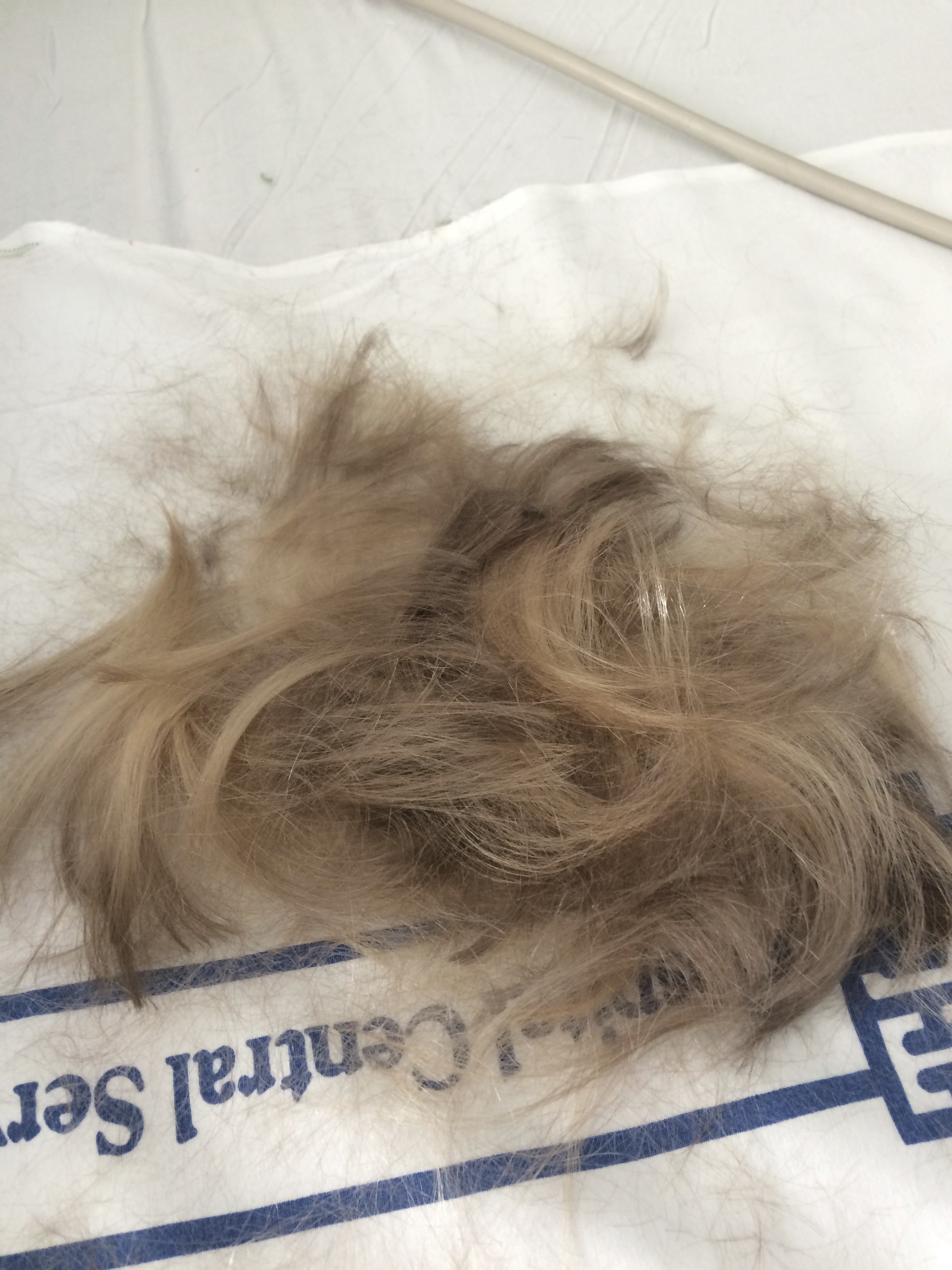
Wednesday had been a particularly hard day.  Sten left the day before, great welling of tears in his eyes as he held her goodbye, not knowing if he would ever again see her with hair.  Who would she be when he came back?  Her hair had started to fall out and began to coat everything, including Doggie.  Hair all over her clothes, in her mouth and food.  I told her I would cut it before I left, but I wasn’t prepared for her request Wednesday morning that I cut it because it was bothering her.  In my unconscious mind, I still had one full day left with her before more of her would be stolen away.  But I knew she was right, and I forced my hand to function and grasp the scissors and not gasp at every cut through the blonde hair that has never had the chance to grow more than five inches long.  And there she sat, part of her gone and in her place a prison inmate, a child being sent to the gas chambers.  We walked a slow drudge to the bathtub room to wash away the debris of life, of a hoped for life, a life that had appeared to be thriving.  I asked the CNA to change the bed while we were gone, to take away the scant pile of blonde clippings.

Two hours of eating lunch only yielded five bites and not even a cup of milk completed.  I had to entrust the nurse to put her down for her nap so that I could drive downtown for the transplant consult meeting with Dr. Marie Bleakley.  I sat across from her just as I had a year and a half ago, to go over the transplant for Allistaire, to hear the heavy realities and hopefully be shown the ray of light in all the pressing darkness.  The one year survival rate for patients getting a second transplant is 25%.  Of those, only half live more than five years.  So 12.5%, that’s the odds, if she can even get to transplant.  In her favor is that fact that she is a child with a healthy body, besides cancer, that because she has not had TBI (total body irradiation) they can give her the most powerful transplant in existence.  Lastly, she was in remission for nearly a year which says something about the aggressiveness of her disease.  However, in order to get to transplant, the doctors will make a subjective decision about whether or not she has “responsive disease.”  They must see a significant improvement in her chloromas (the six places of solid leukemia).  If her disease can march ahead undaunted in the face of these four powerful chemotherapies she has just received, a second transplant is highly unlikely to stop it.  So while, thankfully, there is a transplant that does not require remission, nevertheless, they need to see a disease that gives evidence that it can be shut down.  If this round of chemo does not work, must likely we will go to Denver to do the DOT1L inhibitor trial.

The most optimal transplant for her is the clinical trial, for which Dr. Bleakley is the principal investigator.  What is unique about this transplant, is not the conditioning regimen (chemo and radiation) but what is done to the donor cells.  Dr. Bleakley’s team, in her words, “attaches little magnets to the naive T-cells and removes them, returning the remaining cells to the patient.”  The goal of doing this is to reduce the incidence and severity of GVHD (graft versus host disease) in which the donor cells see the host/patient as foreign and attack the body of the host.  GVHD can be debilitating and even cause death.  So while it is really desirable to reduce GVHD, there is the concern that in doing so, there may be a reduced GVL (graft versus leukemia) effect.  The great hope of transplant goes beyond the decimation of the conditioning regimen, and is more firmly rooted in the science of the donor cells seeing the host’s cancer cells as foreign and killing them.  Forty-six patients have undergone this manipulated T-cell transplant and there are quite promising results in terms of reduced GVHD.  I was also delighted to learn that there has been a reduced incidence of relapse amongst the AML patients on the study.  Dr. Bleakley says that perhaps they are removing some GVL effect when they remove the naive T-cells, but it seems they are also enhancing/enabling the GVL effect more greatly specifically with the AML patients.  An otherwise very soft-spoken woman, Dr. Bleakley becomes much more animated when she discusses the power and hope of immune therapy.  She explains that she and a number of her colleagues were trained under Dr. Stan Riddell at Fred Hutch who was in turn trained by Dr. Phil Greenberg.  The primary purpose of developing this transplant is to provide a platform for the immune therapy that doctors like Dr. Greenberg and Dr. Jensen are developing.  The idea is this – you can’t have raging GVHD which requires immunsuppressants and make use of the wonders of modified T-cells – the fighters of the immune system.  There is no point in being given amazing, super powered T-cells if you just to have suppress them.

Needless to say, listening to her describe this new transplant that would provide the best shot at being able to receive the modified T-cells that Dr. Greenburg is developing, was the ray of light I was desperate to cling to.  Of course, simply getting Allistaire in a position with her disease to be able to even have a transplant feels nearly impossible given how many treatments failed the first time she relapsed.  Then Dr. Bleakley revealed another major barrier to Allistaire being able to have this transplant.  She must have a U.S. donor.  The donor search team has identified a 10 out of 10 donor for her in the German system, but this transplant necessitates a donor from the States.  The reason for this is that as soon as the cells are harvested, they begin to die and degrade.  The manipulation of the T-cells for the trial requires an entire day of work once the cells arrive.  By adding on the time it would take the cells to get from Europe to the U.S., the cells would probably not be in good enough condition for the transplant.  Because the cells are being manipulated, consent from the donor is required.  This process and approval has been set up for the trial in the U.S. with the FDA.  Not only would the cells be too old if they came from overseas, there is no regulatory process in place to allow a foreign donor.  It is possible that there is someone on the registry in the U.S. that could be a match for Allistaire, but that is currently unknown.  The protocol for the donor search process halts the search for a donor once an acceptable donor is located.  The probable reason why it has been easier to find Allistaire a donor in the German system is because the folks on that registry actually pay to be on the registry and renew their commitment annually.  Additionally, I think these potential donors start out with giving a blood sample unlike U.S. donors who only give a swab of cheek cells.  This means that the German system can offer much higher level testing/matching than the U.S. system straight out the gate.  The German registry also pays for the remainder of the testing necessary to determine a match.  In the U.S., it costs three to five thousand dollars to test each potential donor.  This is why the search protocol is to stop the search once a donor is located.  There is no reason to continue spending money to test additional potential donors, if you’ve found one that will work. Dr. Bleakley has instructed the search team to pursue U.S. donors, so we will have to wait and see.  Kind of a wake up to realize that though there may be 22.5 million people on the U.S. registry, there still may not be a person that will match Allistaire and allow her to have the opportunity for this amazing transplant option.  Are you on the bone marrow registry? Click HERE to join.

If Allistaire were unable to get a matched 10 out of 10 U.S. donor, and she was in a position to receive a transplant, she could have a the standard transplant and use the donor from the German system.  Like the naive T-cell depleted transplant, a standard transplant does not require remission but requires the collaborative agreement amongst the doctors that Allistaire’s disease has responded enough to therapy to give the transplant a higher likelihood of success.  The third option is to have a cord blood transplant.  There is debate about whether or not cord blood transplants result in greater GVHD.  The two clear down sides to a cord blood transplant for Allistaire is that it absolutely requires strict remission and it would prevent her from being eligible for the modified T-cells developed in Dr. Greenburg’s lab, as that study requires a matched 10 out of 10 donor.

Yesterday I spent some time on the phone with Kira, the transplant insurance coordinator at SCCA (Seattle Cancer Care Alliance).  At the end of my meeting with Dr. Bleakley, she asked, “So your insurance is going to pay for this?”  Oh dear, I had not even thought of that.  I just assumed we were in the clear because of that awesome bill that was signed into law in 2013 prohibiting insurance companies in Montana from denying clinical trials to cancer patients.  Dr. Bleakley said that sometimes insurance companies with deny all clinical trials and sometimes they will allow Phase 2 trials but not Phase 1.  So a conversation with Kira was in order.  I was baffled and enraged when she told me that the insurance companies have found away to get around that law and can still deny any clinical trial they like.  “They would rather her be dead!”  I cried out.  Healthy is better than sick, but dead is all the better still.  Dead people don’t cost anything.  I asked her if they just deny clinical trials  outright and she said that they used to but that it’s not quite that bad anymore.  She encouraged me that she and her team are here to fight on Allistaire’s behalf and that like the insurance companies, they too have ways to get around the barricades the insurance companies throw up.  She described several different tacts they can take, one of which involved a 30 day appeal process.  “We don’t have 30 days!”  I yelled.  Fortunately, Kira said a number of the appeal processes can take just a matter of a few days.  So there is hope that we can get approval through insurance but the process cannot even begin until the doctors can say that Allistaire is actually in a position to have a transplant.

Bone marrow tests occur between day 28 and day 35 of a round of chemo and necessitates an ANC of 200 or higher.  There need to be enough cells present, indicating sufficient rebound of the marrow, to really determine how effective the chemo was.  Day 28 will be December 17th.  Bone marrow test results take about 48 hours but because she also needs PET/CT scan, we will likely get some telling results on the day of testing.

Every where I turn there are barricades to the road ahead.  At so many points, the door could be slammed shut on Allistaire’s life.  I know that no matter the number of road blocks or the seeming difficulty, nothing is hard with the Lord.  With His word He spoke the world into existence.  These seemingly insurmountable walls are like wee blades of grass to God.  I know He is able.  I don’t know however, what His plan is.  It is hard not to lose hope.  I spoke with a staff person at the hospital a while ago and I know I sounded like the downer because I continued to point out that her death is entirely possible.  The person responded that she and her coworkers could not do their jobs if they did not hope for life for her and so many like her.  Yes I hope for her life, but I cannot have the endpoint of my hope be in whether or not she lives.  My hope must, it must go beyond the grave.  The trajectory of my hope ends in God, it ends in the fulfillment of all He claims is true.  My hope rests in His promises that proclaim that all life is eternal, and life for those that love Him, are with Him for eternity and that He will redeem all things.  He promises that these sufferings will one day be shown to be “light and momentary,” and that they are “achieving for us an eternal glory that far outweighs them all.”  My hope enfolds the hope for her temporal life, and my temporal life, but it far exceeds these and strives on, yearning forward to eternal life, pure, abundant, eternal life with God where sickness and death are forever done away with and life incompressible rises up.

Sunday night, after we finished decorating the Christmas tree and put Solveig to bed, Sten and I sat in the light of the beautiful tree.  How many Christmases have we sat before the tree, the light reflected in purples, blue, pink and yellow?  Last year when I packed up the Christmas decorations, I wondered what this Christmas would hold.  I wonder now what next Christmas will be.  Sten and I sat and cried, heaves and silent sobs.  Every joy I have known with Allistaire, now sits tied and counter-balanced with cutting pain and sorrow.  We ate pancakes Saturday morning and Allistaire was not there.  She was not in the snow seeking just the right tree.  Solveig hung the ornaments that were Allistaire’s, carefully selected each year with the intent that one day she would have her own home, her own Christmas tree.  When the three deer crossed the snowy meadow, I could not call to Allistaire, to quick, get the binoculars.  She was not there.  Will the brightness of her eyes ever again cheer eagerly at the sight of animals in the field?

Being home was hard.  My imagination so honed.  But being with Solveig was wonderful.  When Solveig came out over Thanksgiving, the priority was for she and Sten to spend time with Allistaire.  At home, we had the joy of spending time together in ordinary ways.  It really was a full, wonderful four days.  On Friday, I took Solveig out of school early to get her flu shot and head over to The Coffee Pot, Solveig’s favorite lunch spot.  Then on to my favorite antique store and a few errands before we met up with Sten to go see Big Hero 6 all together.  The night finished up with burgers at Ale Works, another favorite of ours.  Yes, we settled down into the booth in the train car where we four have often sat.  There was an empty place at the table that threatened to steal the joy of the present, and clamp down sorrow.  But on we went.  Saturday we slept in and then had chocolate chip and apple pancakes.  We drove up past Bridger Bowl and used our $5 Forrest Service pass to get a happy little bright green pine tree.  I put away the Halloween decorations that have just sat unattended.  Later in the afternoon we went into to town where Main Street is closed off for the Christmas stroll.  This year it was nearly 60 degrees warmer than last year.  We enjoyed the artisans at SLAM fest and then a great dinner and show at our favorite venue, Peach Street Studios. It was a splendid day all around. On Sunday I had the joy of hiking the M with my friend Hope and talking over breakfast.  Lunch was with dear April and the unexpected conversation with Nate.  Sunday night we finished up the Christmas decorating.  The garland and trees, the light-up snowman for Allistaire’s room sit still in the dark boxes, hoping for use another year.  On my last day, I spent hours at breakfast with Pam, my dear, dear friend who knows best this hard road.  I could never have imagined the gift of her friendship.  We have committed to be there for one another.  We dream of our children being adults together, but come what may, we look forward to the hope of being gray haired old ladies together.  Jess and I, spent time and rejoiced at already having nearly 15 years of friendship.  Jess blessed me with tear filled green eyes and tales of missing me.  The afternoon wrapped up with an appointment with the social worker at the Bozeman Deaconness Cancer Center to explore options for counseling and then an all family get together at our house over pizza, salad and cherry crisp.

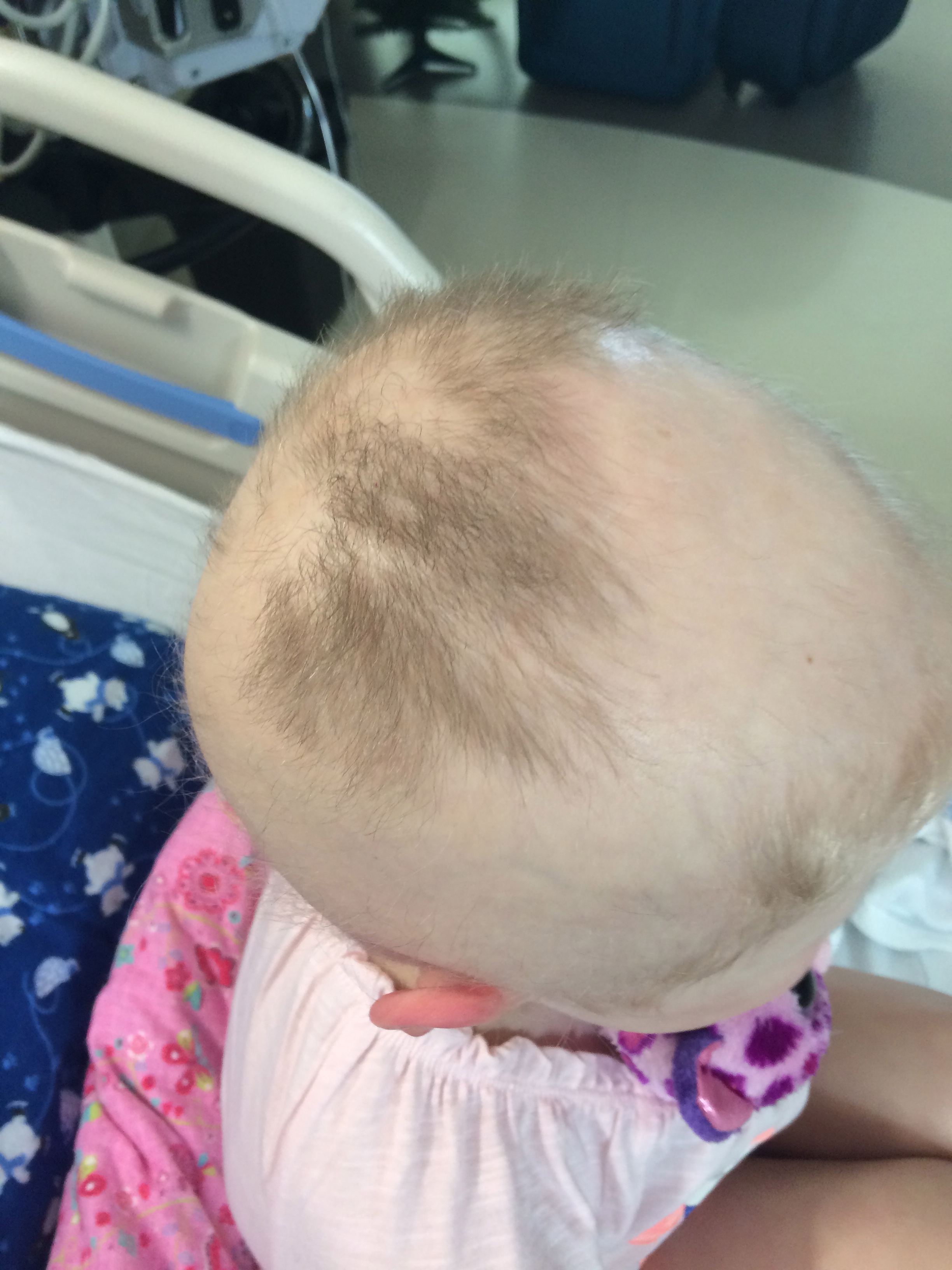
Solveig could be heard crying in her room after I put her to sleep.  Another leaving.  Unknown days.  A black wall of unknown past December 17th.  With trepidation I walked the hall to Allistaire’s room at the hospital, fearful of blood counts and possible blasts.  Rather, I was greeted with the sound of Allistaire’s laughter with Papa in the room while I talked with Kathy the nutritionist who says she has one and a half kilograms wiggle room with her weight before a feeding tube would need to be seriously considered.  Then Dr. Leary appeared for rounds with news that both her ANC and ABC (Absolute Blast Count) remain at zero.  Oh how I love, love, love that little girl.  I laughed out loud when I saw her very silly head, now far more bald with the exception of the fringe of wispy blonde hairs framing her face and neck.  What is hilarious is the spiky brown hairs in the back that stand with resolute determination to stake their claim to her cranium.  They look like the have no intention of going anywhere but maker her look so very silly.  She was full of joy and glee, drawing and coloring at her table.  On Wednesday night she had spiked a fever, which necessitated blood cultures and broad-spectrum antibiotics until they could determine the source of the infection.  When I left on Thursday, she was a feeble little child who wouldn’t eat and only wanted to lay in bed with warm packs on her tummy.  She has had constant diarrhea for the past few weeks and seems to have pain from cramping.  It was hard to leave her when all I wanted was to curl around her and bring comfort.  So it was exceptionally lovely to find her in much better spirits.

We are twenty-two days into this round and 14 days of zero ANC.  We wait.  I try to get as many calories in her as possible.  Oreo shakes have seemed to help that task a bit.  I don’t take it a day at a time.  There are windows of hours and moments that require the aid of the Lord.  I told Nate about manna.  Such a crazy tale, but really so beautiful.  The Lord provided manna for the Israelites in the desert for food.  But only for a day.  They could not save or horde the manna.  They had to trust the Lord that He would again provide for them the next day.  They had to put their hope in His faithfulness, His sincere love for them and His actual capacity to provide.  I eat the manna.  His mercies are new every morning.  Great is His faithfulness.

IMG_1918 IMG_1921 IMG_1923 IMG_1925 IMG_1928 IMG_1931 IMG_1933 IMG_1939 IMG_1941 IMG_1944 IMG_1946 IMG_1949 IMG_1953 IMG_1956 IMG_1959 IMG_1961
IMG_1966 IMG_1975 IMG_1979 IMG_1982 IMG_1985 IMG_19863 Years ago, December 9, 2011:

DSCN4615 DSCN4616 DSCN4621 DSCN4626

Dread, Hope, Dread

Standard

IMG_1612I know I should go to bed but I know that when I do, tomorrow will hasten its coming.  So fast it will fly and then we will have arrived on the threshold of that day we must enter the hospital.  I strain to slow my steps as though I can with force of will prevent the series of events which will come, which must come to bring us to Wednesday morning.  The halls are bright with light and the colors, blue, orange, green are meant to be cheery, modern.  But to a prison cell it feels we are being sent.  And the dread is not because of the annoyance of people perpetually coming and going or the fact that we are closed into a tiny space where no normal advances of life can take place, where we are stunted in 4 hour cycles of vitals.  No, that is endurable, that is bearable.  The dread, though weighty, sinks slow and silent, settling firmly in my heart, in my gut.  Will she ever leave again?  Will the sweet small child who walks through those doors ever, ever return?  I KNOW what happens in that place.  I know what terrors lurk.  I feel as though I’m walking my child to the gallows.  I’m doing this, in her innocence, I lead her into that place.  But I have no other choice.  I must hand her over.  It’s breaking my heart to know what will soon be done to her, again.  How can she endure?  She is so small.  And she must do it all over again for a second time.  My heart tears with screams – how can I be forced to choose between these poisons and destroyers of chemotherapy and radiation, and her death?  Neither are good!  I despise being crammed in this wretched crack of murderous choices.

But I yield.  I take her by her small, warm hand and I will lead her in.  It does not take long in the fight against cancer to know so clearly how each step forward is gift, pure, free, underserved, gift.  For you see those falling away around you and you know how very fortunate you are.  The sun has shone upon you, you are the blessed and you have absolutely no room to grumble or complain – for you still stand.  I don’t know what the days ahead may hold.  I don’t know how long we will be locked in that place or if ever, ever my beloved Allistaire will come out, marred, but alive and radiant.

This morning we went to clinic and Allistaire had labs drawn, then we saw the nurse practitioner.  At the end of the appointment we had the joy of having Dr. Gardner come by as well.  She was able to relay the discussion regarding Allistaire that the Hem/Onc and transplant doctors had this past Thursday.  They agreed to prioritize a clinical trial transplant whose aim is to reduce Graft Versus Host Disease (GVHD).  Based on Allistaire’s HLA (Human Leukocyte Antigen) typing, they are optimistic that they will be able to find a 10 out of 10 matched, unrelated donor that will fulfill the protocol’s requirements.  The trial is testing the efficacy of removing “naive T cells” from the donor cells and returning the remaining cells to the patient, leaving the memory T cells.  For those new to bone marrow transplants, the idea is not only that you myeloblate (utterly destroy) the patient’s marrow in the hope that you also destroy the cancerous cells, but that the real beauty of transplant is mythical GVL (Graft Versus Leukemia).  When you receive the infusion of the new donor cells, these cells enter the patient’s body and sees their body as foreign.  The immune system is created to search out and destroy what is foreign and unwelcome.  This means that both healthy and cancerous cells may be attacked.  The attach of healthy cells is known as GVHD and the attack against cancerous cells in the case of leukemia is known as GVL.  So this transplant is designed to remove the T cells that indiscriminately destroy and leave the rest.  While I love the thought of less GVHD, I asked Dr. Gardner with concern, whether or not such a transplant would produce diminished GVL.  With a smile, she said, no, they don’t think so, they have had very promising results.

Another upside of this transplant, is that with diminished risk of GVHD, there is a greater likelihood that Allistaire would be in a better position to receive the infusion of the modified TCRs (T cell Receptor).  When you have GVHD, one may need to go on immune suppressants, often steroids, to reduce the immune response of the T cells.  The most common places under attack are the skin, liver and gut.  It would make no sense for Allistaire to receive fancy, modified T cells only to suppress them with steroids, rendering them ineffective.

Perhaps the greatest ray of hope, came with the words, “transplant without remission.”  It sounds like the transplant doctors are still willing to go ahead with this transplant, even if Allistaire is not in remission.  To qualify for the trial, Allistaire would have to have 10,000 or less circulating peripheral blasts, a 10 out of 10 matched, unrelated donor, and generally be in good condition (organs functioning well, no out of control infection, etc.).  Dr. Bleakley, the principal investigator for the trial at Fred Hutch, does not view Allistaire’s chloromas (solid leukemia outside of marrow), as disqualifiers.  Of course it would still be optimal for these spots to be gone or substantially so, but their presence would not close the door for her.  It may mean, however, that she would need focalized radiation to these locations in addition to TBI (Total Body Irradiation).

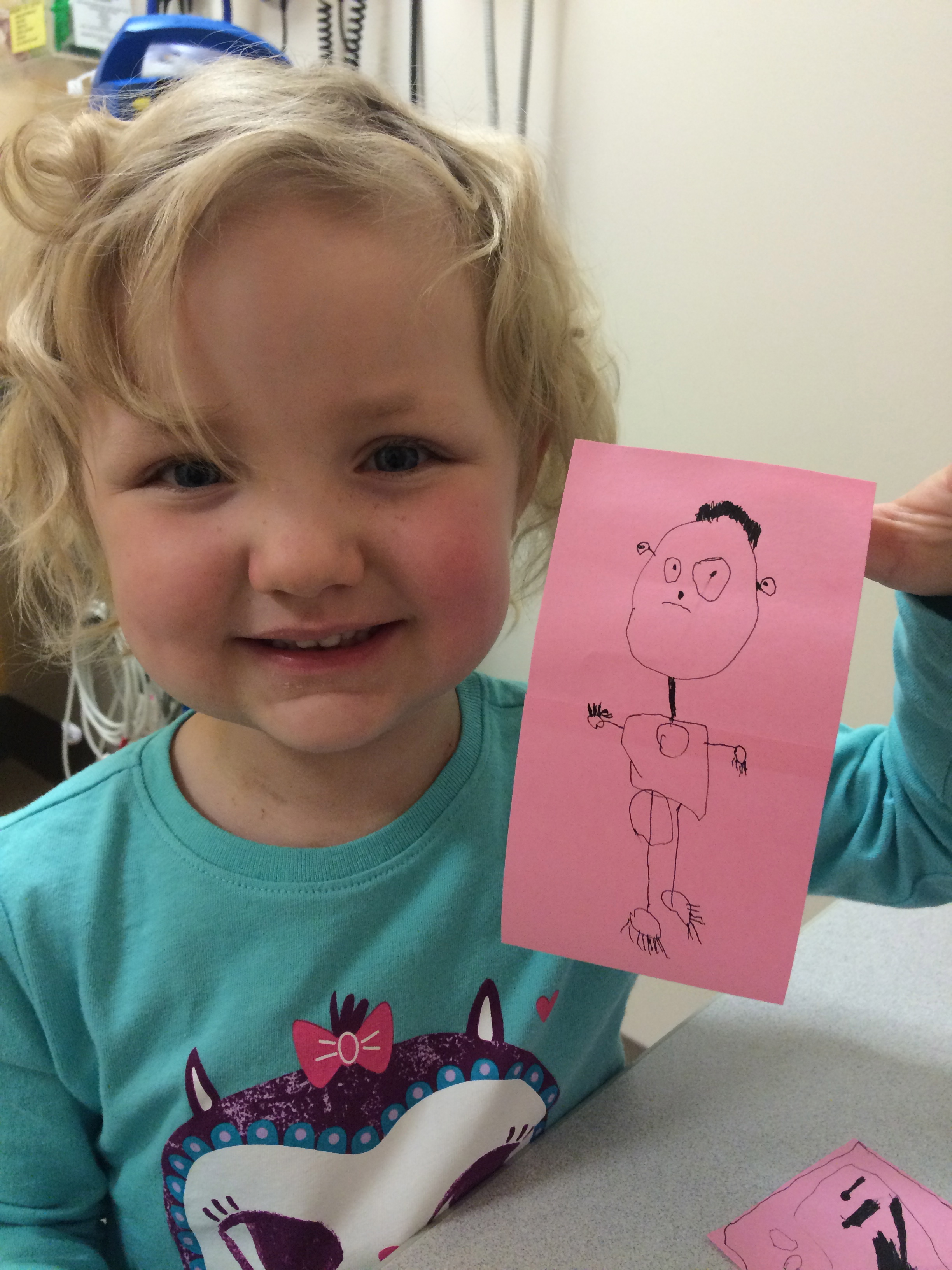
Suddenly, the yellow walls of the room felt fitting for the hope swelling in my chest.  There may be a way through.  There is a ray of hope.  That is what I needed to face an indefinite inpatient stay.  Knowing there is hope, spurs one onto fight.  Before this conversation with Dr. Gardner, it just seemed like this was all doomed to fail which made it all the harder to willingly walk into that lock-down prison.  Good fortune continued with Allistaire drawing her first person and getting bumped up in the schedule for her “back poke,” where they test her spinal fluid for leukemia and inject a chemo, cytarabine.

Allistaire had just been wheeled into the recovery room where they practically kick you out 5 minutes after a procedure, when our nurse practitioner walked in with the lab results.  In the appointment we’d had everything back with the exception of the ANC (Absolute Neutrophil Count) which always takes longer.  All her labs had looked great, despite her falling blood counts which are naturally to be expected because of the advance of her leukemia and the chemotherapy.  The ANC was fine, 1022.

The absolute smack in the face was the presence of an Absolute Blast Count – 68.  Blasts are immature cells and they can be completely normal depending on their location and number.  Blasts in the peripheral blood, and of more than just a few, are most likely leukemic.  There was that wretched number declaring the very real increase of her cancer, such that it has pushed out cancer cells into the bloodstream, and this, even in the face of seven days of chemo.  Now, Decitabine is not a hard-core chemo, is known to take a while to be effective and is not what we are relying on to get her cancer into remission.  Yet, it makes you want to throw up on the spot.  Blasts are the harbinger of things grossly out of control in the marrow.  Their presence stings and burns the mind.  Blasts were the evidence that every round of chemo prior to her first transplant had failed.  It is not an overstatement to say that they strike terror.

All the hope I had known in that yellow room thirty minutes before, seemed to have been violently suctioned away.  I felt panic and desperate need to talk to Dr. Gardner about this most wretched development.  She appeared shortly and said in short, “I don’t want to blow it off, but it does not add to my level of concern.  It does not surprise me and it doesn’t change our plan.”  She affirmed all of my assertions regarding Decitabine that I had quickly thrown together in my mind.  Well, I would have felt a lot more free-spirited joy had those blasts never shown their ugly faces, but all hope is not lost.

For now it is late, but I have one last morning to sleep in and snuggle with my girl, just the two of us.  No lights, no pumps or beeping sounds, no interruptions for vitals.  One more morning and day of seeming normalcy.

For more information on the transplant trial, click the link below.  The trial for the modified TCRs is below that.

Selective Depletion of CD45RA+T Cells From Allogeneic Peripheral Blood Stem Cell Grafts for the Prevention of GVHD

Laboratory-Treated T Cells in Treating Patients With High-Risk Relapsed Acute Myeloid Leukemia, Myelodysplastic Syndrome, or Chronic Myelogenous Leukemia Previously Treated With Donor Stem Cell Transplant

Explanation of TCRs from the Juno Therapeutics Website

IMG_1561 IMG_1562 IMG_1570 IMG_1572 IMG_1577 IMG_1580 IMG_1590 IMG_1597 IMG_1604 IMG_1608 IMG_1611
IMG_1613 IMG_1620 IMG_1622 IMG_1623

Roadmap

Standard

IMG_1466I’ve been to Target several times since leaving home.  I keep thinking of things I’ll need in the hospital to streamline my life.  Living in a hospital takes strategerie.  Now, if you’re there for a few days, even a few weeks, you can just sort of role with the discomforts, annoyances, and inconveniences of hospital life.  But that’s not what we’re up against.  We are facing months and months of living in the hospital.  When Allistaire relapsed the first time, she lived in the hospital for one hundred and forty-eight straight days.  I was there for most of that.  And living in a hospital is like living in a foreign country where things are just done a different way than at home and you can’t access the things you have come to expect and need.  There are awesome upsides to hospital life, like – I never have to clean the toilet or buy paper towels or launder my sheets.  I have free, crazy fast wi-fi and more cable channels than you can imagine.  But on the flip side I have to accept that people will be coming in and out of our tiny little space all day and throughout the night.  There is almost no privacy.  One learns to sleep on strange pull-out-couch-beds with lights, clicking sounds, beeping, alarms, frequent calls for your attention, for assistance.  In the morning, I gather my things in a Trader Joes’s bag and walk the 100 yards down the long white hall to the showers wherein I don my purple plastic flip-flops.

It’s weird how normal all of this feels.  The last two mornings Allistaire and I have enjoyed the quiet of the Hem/Onc infusion clinic on the weekend.  The normal bustle of the hospital is replaced by emptiness and calm on Saturdays and Sundays.  We go check in with the nurse who must “lay eyes on her,” before she can order up the chemo from Pharmacy.  We know our usual rooms we are assigned to because Allistaire is in contact isolation until the end of time, due to having VRE (Vancomycin Resistant Enterococcuss).  We joke with the nurses, many of whom we know.  The nurse practitioner drops by to say Hi and says how sorry she is, with tears in her eyes.  It’s all the same, the same routine, round and round.  We have been here countless times before.  There is odd comfort in that.  But it is a comfort that also leaves you agitated because it all still feels so fundamentally wrong.

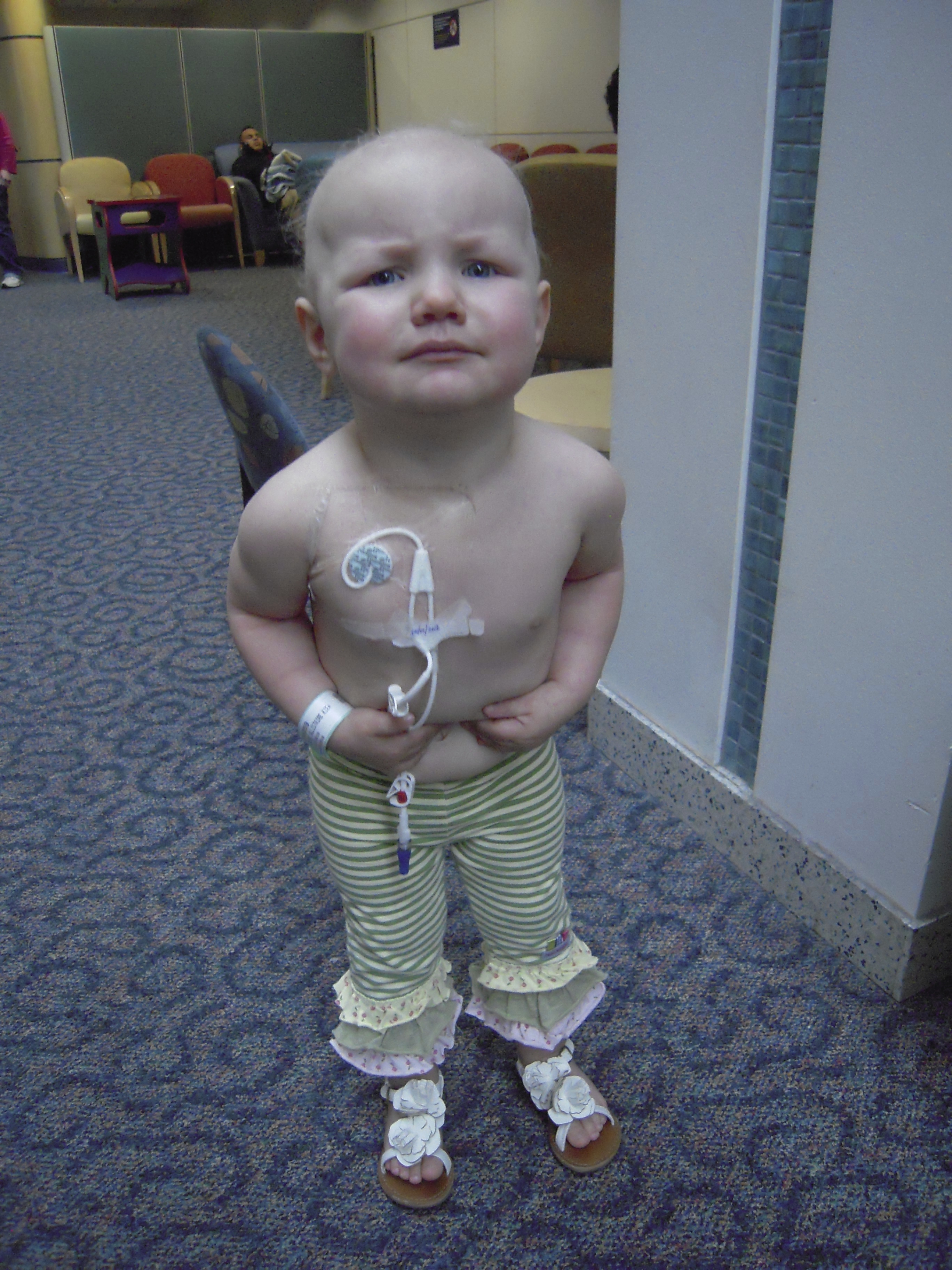
Allistaire has been doing alright, often cheery but no longer her normal self.  She’s getting more fatigued, cries more easily and can become overwrought by the smallest thing.  She has intermittently been in pain which mysteriously comes and goes.  On Thursday when Sten flew home, I had to give her four doses of oxycodone to address her strange back pain.  Now it’s gone.  At another point she suddenly bursts into tears that her foot is hurting and she struggles to walk.  The last few nights she has woken me four or five times with crying in her sleep.  I go to her and ask if she’s in pain; she is disoriented and says No.  On Friday morning, she had surgery to place her Hickman Line.  It hurt my heart.  Her body has no massive scars but rather a myriad of small ones, four biopsies of leg, back, lung and arm, nineteen bone marrow tests has created a scarred dent on the lower right of her back, four scars on her chest and neck from the previous two Hickman’s and now this new one with its tender wounds.  There hang those handy but wretched “tubies.”  All these outward signs of the fight within.  I’m finally getting over my denial.  Her hematocrit had dropped to 32.  I was finally ready for her to get chemo.  I finally unpacked my bags last night.

Once again, our life seems to have been shattered and in a disarray.  I knew this could happen.  I knew that if I took Allistaire to the doctor, it could be like willfully walking off a cliff.  So I stalled and I hoped it was all nothing and would simply go away.  The last two weeks have been a whirlwind and simultaneously brutally slow in determining what lies ahead.  Because, man I just want to know.  I just want to know what we’re doing here and how it’s all going to work out.  I walk through the grocery store and see Thanksgiving napkins and turkeys.  In Target all the Christmas decor is emerging and it sounds so lovely to be planning for a big family meal and a pretty mantel and tree.  They are all pinpricks, little relentless jabs that remind how different life is from how we thought it would be, how we long for it to be.  Friends inquire when they can come visit and I look out into the night and see no landmarks, nothing to give perspective on distance and time.  I scan the horizon and all I see is void.

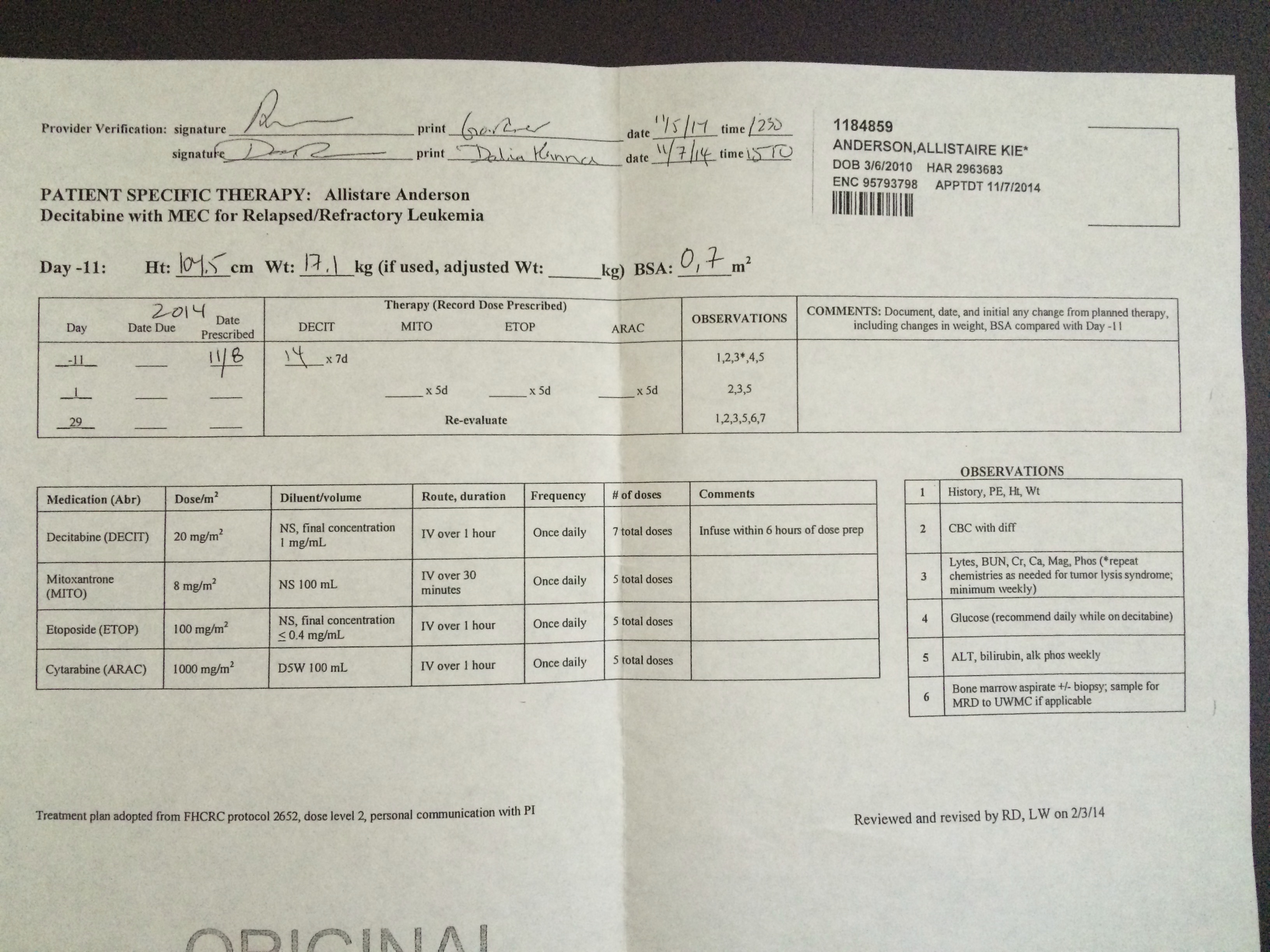
I suppose they name it a “Roadmap,” to make you feel a little better, to inspire some confidence that we all know what we’re doing here.  We have purpose.  We have a plan.  We have a roadmap.  And we do have a plan and I really can’t complain.  It creates some framework, some structure to the days ahead.  It feels like we get to be intentional, well thought out and that gives the impression of control.  And oh how we hope it is not an illusion but actual control, actual power over those wily cells, so resilient and persistent. The Roadmap says that Allistaire will receive 7 days of Decitabine, each for a one-hour infusion.  She will then have four days off, her last days of freedom before being admitted to the hospital on Wednesday, November 19th.  Starting on the 19th, she will receive an infusion of Mitoxantrone, Etoposide and Cytarabine each day for five days.  The next twenty-four days will be a matter of waiting for the chemo to takes its effect, protect against infection, address pain and nutritional needs and provide platelet and red blood transfusions due to her decimated bone marrow.  Once her marrow has sufficiently recovered, thus also giving any remaining cancer cells time to recover, another bone marrow test and PET/CT scan will be done around day 28.

Beyond December 17th, I have really no clue where we’ll be.  If this round of chemo fails, it’s very possible we’ll head to Denver for the DOT1L trial.  If, gloriously, she’s in remission sufficient for transplant, then conditioning (chemo & radiation) for transplant would begin in earnest. In order to have a transplant, however, she needs a matched donor.  In March of 2013 when they searched the world for a donor for her, they only came up with 2-3 possible options, none of which were in the United States.  I just received paperwork from SCCA (Seattle Cancer Care Alliance) about reinstating the donor search for her.  I was blown away when I read that there are 22.5 million people world-wide that are registered donors, and yet – there were less than a handful of options for her last time!  That’s wild!  That tells you how critical it is that more people join the registry because our genetics are so diverse and are becoming more and more so as ethnic groups intermix and have children together.  So we pray again for a donor.

I have to say that I’ve been feeling pretty down about Allistaire’s prospects.  I think if she can get to transplant, then she has a shot, a very narrow, small shot, but a real chance nevertheless.  But I look back to the last time we tried all sorts of chemos to get her in remission and absolutely none worked.  I was encouraged though last Thursday when a mom that I met said that this DMEC round is what put her son into remission for his third transplant.  I met her at a little party I was invited to.  But really, it wasn’t little at all.  There may have been less than 20 people in the room, what we were there to celebrate is phenomenal.  You see, a nine-year old boy, Zach, died last January after complications from his third transplant for AML.  In all the years that Zach fought cancer, his parents, Julie and Jeff, were determined to scour the earth for options to save their boy.  They had the resources to execute a phenomenal search for Zach’s cure.  Their journey led them here to Seattle to Seattle Children’s and Fred Hutchinson Cancer Research Center.  They began to work with Dr. Phil Greenberg at Fred Hutch as he and his lab were advancing the potential to use TCRs (T-Cell Receptors) to destroy cancer cells.  “Data from early phase clinical trials have demonstrated the capacity of high-affinity TCR Tcells to eradicate leukemia in individuals who have relapsed after a hematopoietic stem cell transplant.” (Quoted from the Juno Therapeutics website where Dr. Greenberg is one of the scientific founders).  The death of their son, Zach, has only fueled his parents’ passion to work even harder to bring better options to kids like Allistaire who have very difficult to treat AML.  In the course of the last twelve months, Julie and Jeff have spearheaded fundraising efforts to benefit Dr. Greenberg’s lab that has provided 1.7 million dollars to further his research.

Their efforts and the generosity of so many people combined with the countless years of tireless research by not only Dr. Greenberg and his lab, but many others at Fred Hutch and Seattle Children’s Research, have yet again intersected with our lives.  Apparently Allistaire’s school pictures arrived after we left Bozeman.  I realized yesterday that I never cleaned out her little cubby with her paint shirt, gym shoes and pencil box.  When we drove into a parking garage the other day she yelled out, “B!”  I had no idea what she was talking about until I realized we were on Level B and again the cut twisted in, the combined joy of realizing she was beginning to learn her letters that would eventually enable her to read and the pain of knowing she would never return to preschool.  That experience is forever cut out of her life.  There are countless ways our lives are not what we thought they were going to be or so desperately wanted.  But when I look back to August 2013 and consider where the doctor said we would be, Allistaire in the ground, I am heartily reminded that I have ever so much to be thankful for.  And one of those gifts that extended life has produced is the possibility that Allistaire might be the recipient of these marvelous genetically modified T-cells.  I had the chance to speak at the party for a few minutes and tell Allistaire’s story.  I told the story to the members of Dr. Greenburg’s lab, each amazing scientists in their own right and the majority of whom are women.  There were many red faces with tears.  Allistaire was there to be the tangible reminder of why they work so hard.  We had the chance to talk with Dr. Greenburg briefly.  What an unexpected gift all around.

I look out into the void and strain to see landmarks showing the way ahead.  I just can’t.  I just have to dwell in the present.  That’s not so bad really, I mean it’s contrary to what my nature prefers, but the Lord has given me weapons to aid me in the fight to rest.  Isn’t that ironic, I must actually fight, wrestle to rest.  But that’s what this battle actually is at its core.  So, I eat the manna, God’s provision for me this day.  I rejoice knowing He has gone before me and laid down provision up ahead.  He opens and closes doors to guide me along the path He has chosen for us.  He holds Allistaire in the palm of His hand.  I could really go on and on and on about The Lord’s all sufficient capacity to care for us.  This is what I do when the dark waters rise and threaten – I focus my eyes not on trying to see the way ahead, but rather I fix my eyes on Christ, being reminded that He is THE way.  My friend Betty, showed me this great profound and simple passage in 2 Chronicles 20.  The Israelites are surrounded by invading armies, and they sum up their battle strategy with this as they cry out to God, “We don’t know what to do, but our eyes are on you.”  Perfect.

On a side note, I will be putting out a post in the next couple days on specific ways to help.  For now, I have updated the page, “How to Visit & Send Mail”

The first few pics below document Allistaire’s previous two Hickmans.  The first was at diagnosis in December 2011 when she was 21 months.  This one was removed in May 2012.  She got her second Hickman upon relapse in February 2013 just before she turned 3.  That one was removed in March of 2014 when she turned 4.  And here we are at number 3 with her second relapse in November 2014 at 4 1/2 years old. Unfortunately the surgeon was unable to put it on her right side again, but everything went smoothly on the left.

A few links worth checking out:

Juno Therapeutics 

Zach Attacks Leukemia

Fighting Fire with Fire

Be The Match

DSCN4661 DSCN5281 DSCN5284 IMG_1485 IMG_7824 IMG_7887IMG_1474 IMG_1483 IMG_1491IMG_1452 IMG_1458 IMG_1461 IMG_1512 IMG_1514 IMG_1515 IMG_1523 IMG_1531 IMG_1526 IMG_1529 IMG_1536

One Year Post-Transplant Long Term Follow Up

Standard

IMG_9471“The peace is partly in being free of the suspicion that pursued me most of my life, no matter where I was, that there was perhaps another place I should be, or would be happier or better in.”         ~Wendell Berry

I went to see, “A Fault in Our Stars,” the other day. I wanted to see how Hollywood would portray pediatric cancer, this time in a group of three teenagers. One line stood out to me. Hazel Grace, one of the main characters that has battled cancer since she was 13, said something along the lines of, “I just don’t want this particular life.” I get that. How many times have I looked out over the landscape of my life and these gut wrenching circumstances and thought, “Can I just trade this life in for another?” This is definitely not the life I envisioned for myself.

Why subject myself to two hours of woe? Why do I need to watch cancer ravage more lives, even if they’re fictional? I knew my heart would be battered again but I find myself at times willfully choosing to thrust myself into the midst of a sad story, not for some masochistic desire for sorrow, but really, for love. I have a hypothesis. If we cultivate our imagination, we increase our ability to empathize and demonstrate compassion, and thus, to ultimately love better. One reason I delight so in stories is that they put me in the place of a person I can never be. I will only ever live one life. But stories craft a world for me that allows me to enter in and see histories and places and lives that are out of my reach, that are foreign to me. In stories I am offered a view through someone else’s eyes and I can begin to grasp the joys and wounds of another time and another place. We moved to Montana in part for our girls to have more opportunity to cultivate their imagination. How wondrous that rock and stick and hill can supply such grand stories. How even more fantastic that imagination can make our hearts swell with compassion as we imagine ourselves in the place of friends and family whose beloveds have been shot down in yet another school shooting.   Empathy drives compassion which in turn produces acts of love.

Perhaps I am in greater need than the average person to cultivate this need for imagination driven love, for I am actually quite poor at loving well. I lit into Sten the other morning, going on and on about how I couldn’t stand the smell of his after-shave. When I saw the wounded look on his face, compassion did not rise up, defensiveness did. When I berate Solveig for some failing, what I have so often failed to do is put myself in her shoes, imagine life from her sweet 7-year-old eyes. I rage and bellow because I see only from my finite perspective.

I wonder too if imagination might aid me in faith. There have been quite a number of points over the last 3-4 years that I have surveyed my life and wondered, “Hey God, I’m not really sure how this is/was a good idea.” “Hey God, really? This is your grand plan? You think this is a good way to go?” “If you’re in control, why would you let this or that happen?” God calls me to trust His word, His promises. He calls me to walk by faith. In the book of Hebrews it says, “Now faith is confidence in what we hope for and assurance about what we do not see…By faith we understand that the universe was formed at God’s command, so that what is seen was not made out of what was visible.” God is up to something. The creator God is creating something out of this little life of mine. What will one day be visible is not visible now. What will be seen is not made of what is now visible! God gives glimpses in His Word of what will one day be visible, of the bounty He promises when His plans are complete. God has given me glimpses of how He has and is using these tedious and brutal days. My imagination for what may be, fuels my faith to rest in His promises.  I am banking on the hope that there is more to all this than I can see.

One year ago, I could not have imagined Thursday, June 5, 2014. It was my birthday. I turned 39 and I got the most phenomenal, glorious gift I could ever ask for in this temporal life. One year ago, Allistaire was undergoing daily radiation and then eradicating chemotherapy in preparation for her bone marrow transplant. A year ago, I sat across from Dr. Dahlberg who started our meeting by saying that what we should be talking about is how there is nothing left for Allistaire, how a bone marrow transplant would give her a less than 10% chance of survival and therefore, it wouldn’t be offered to her. A year ago, her cancer had spread to eight places outside of her bone marrow and suddenly halted. No organ was touched by leukemia. A year ago, we were wading into deeper and deeper unknown and desperate, desperate hope that somehow, some way this clinical trial for transplant without remission provided through Fred Hutchinson Cancer Research Center, would save her life. A year ago, I had wondered countless times what the Lord was up to.

As I sat across the conference room table from Dr. Carpenter, in a small room looking out over Lake Union, I could not have imagined this day would ever come.

“It doesn’t get better than this,” he said. Oh how I cherish and savor those words and run them over my mouth and mind over and over, in shocked, joyous exaltation. “It doesn’t get better than this.” On Monday, June 2nd, Allistaire had 11 vials of blood drawn for a phenomenally long list of tests. In the following three days she had an echocardiogram, an EKG, a bone marrow aspirate, a skin biopsy, a CT and saw the cardiologist, the physical therapist, dentist, ophthalmologist, nutritionist and the oncologist. Every single test, everyone, was good. The flow cytometry test showed zero percent detectable leukemia, or as the pathology report reads:

Interpretation

Bone marrow, aspirate: No abnormal myeloid blast or monocytic population identified (see comment).

Comment

There is no immunophenotypic evidence of residual acute myeloid leukemia by flow cytometry.

Clinical

4 year-old female with history of AML.

Immunophenotyping by flow cytometry after lysis of the erythroid cells reveals that the white blood cells consists of .34% blasts (CD34+), 77.4% maturing neutrophilic forms, 5.4% monocytes and 13.1% lymphocytes.

This is how the Lord shouts His good gift to me, in these strange, wondrous words that delve the marrow of my child.

The cytogenetics/FISH report says this:

Result Summary: Normal female karyotype; No evidence of MLL rearrangement by FISH

Interpretation: These results are consistent with post-transplant disease remission.

The chimerism test showed 100% donor cells!

Her heart is functioning normally and is not dilated. Her kidney function is normal. Her liver function is normal. Her strength and flexibility are normal. There is no evidence of Graft Versus Host Disease (GVHD) in her skin, mouth, eyes or anywhere!

Her lungs show marked, significant improvement since being on steroids for the last 3 weeks for her Cryptogenic Organizing Pneumonia.

Even her immune system, her “immune reconstitution,” as they call it, is doing amazingly well! Dr. Carpenter said that he was impressed at how well her various cell types are doing. A number of her white blood cell types are at totally normal levels. Others are better than the average person one year post transplant – even despite 7 months of chemo after transplant. I cannot tell you the phenomenal number of details they looked at in assessing Allistaire but the sum statement is:

“It doesn’t get better than this.”

Yes, there are down sides.  Most specifically, the targeted Busulfan, one of the chemotherapies that was part of the conditioning for transplant (as in the napalm of chemo), has most likely had a very toxic effect on her ovaries.  This means that we should expect that she is infertile and additionally, because her ovaries may not be able to produce hormones as they would were they healthy, she may have delayed puberty and need hormone replacement.  On the other hand, this particular clinical trial transplant did not include TBI (Total Body Irradiation) as the originally planned/standard transplant would have.  What this means is that her body was essentially saved from a nuclear blast and that her pituitary gland and thyroid have been left largely untouched.  TBI would have opened the door to a whole host of awful “Late Effects” as they are called.

Dr. Carpenter is such a professional that the meeting was fairly low-key, but inside my mouth was gaping and my heart was racing around doing little giddy twirls.  Thank You Father God!  I could never have imagined such a day.  Oh I hoped for it desperately, but in a way, for a long time, I didn’t even allow myself to look this far down the road. But here we are.

A few days ago I took Allistaire in for her first set of vaccinations.  All those many rounds of shots from infancy were wiped clean gone along with her marrow during transplant.  At this point she can begin getting all of her vaccinations with the exception of those that include live viruses, such as Measles, Mumps and Rubella.  For these, she must wait for one year once she is off all immune suppressants (steroids).  And as a little side note for those who have not or are considering not vaccinating your kids.  There’s a lot to say on the subject, but one point to consider is that there are those like Allistaire who simply cannot be vaccinated.  They are left exposed, without defense, to horrifying diseases that can cripple and kill if contracted.  When every child that can be vaccinated is, it tremendously reduces the likelihood that a sweet girl like Allistaire who cannot be, will ever be exposed to these awful diseases.

As we drove into town to go get those dreaded shots and Allistaire’s eyes welled with terror and tears, I found myself attempting to explain to her why these shots were worth it and why she needed them.  I told her about the strong medicine that killed the blood in her bones so that it would also kill the cancer that lives there.  And then I began telling the tale of how a woman, my own age, on the other side of the planet loved her, even though she has never known Allistaire.  How this woman was willing to endure the pain of shots so that her bone marrow would release those magical stem cells into her peripheral blood and how yet another needle pierced her skin, this time to collect those cells.  An airplane crossed over the North Pole where Santa lives and landed in Seattle.  Then a truck picked up the little white cooler that held the cells and eventually they arrived at Seattle Children’s and I found myself walking down the hallway behind that swift, purposed woman who carried the cooler, all the way to Allistaire’s room.  I was crying as I told Allistaire these details and of the color of cells in that little bag and how they hooked the line to her tubies and the stem cells flowed in.  I am still so humbled that this woman who doesn’t know us, would love us so tangibly.  Perhaps she was able to imagine that there might be someone on the earth that would one day desperately need what she was able to give, and so she determined to join the bone marrow registry in her country.  Thank God for imagination.

It is Friday the 13th.  Quite a good day really.  In five days it will have been one year since that joyous and simultaneously anti-climatic day that someone else’s blood began to flow into Allistaire.  For one year, that European woman’s stem cells have made their home in Allistaire’s bones and have been doing one amazing job at producing red blood and platelets and white blood cells.  Now those white blood cells will get a glimpse of diseases they have never seen (polio, hepatitis, pneumococcal and many others).  And in all the miraculous wonders of our flesh, those white blood cells will fight and win and store the knowledge of their weaponry and victory, to stave off any future attacks of even greater force.  I am ever in awe of all of it – all of it – the intricacies of our body and how it can actually keep us alive despite so much working against it, the generosity of those who have given bag after bag of red blood and platelets and the thousands it takes to make one bag of Immunoglobins, the woman who gave her stem cells, the myriad of doctors and professionals who tirelessly give of their time and brilliance, the phenomenal generosity of those who give to Seattle Children’s and Fred Hutch to make all this medicine and testing and care possible, the blue sky and wind and a sun that rises every day and flowers that somehow come back every spring, for millions of prayers uttered into the expanse – trusting that God will hear and care and answer as He chooses, for a God that looks down from on high and considers each of our hearts, all of our ways, who knows the number of hairs on our heads, and who interjects Himself in the most surprising of ways into our world.

I have SO much to be grateful for – SO much to give thanks for.  So, we’re planting a tree.  I bought a tree for $49 the other day at Cashman’s nursery – a Radiant Crabapple with gorgeous pink blossoms.  We will sink its roots into the Montana earth and water it and protect it from predators (deer and moose) and delight in its beauty and its reminder of all that God has made possible in the past year.  And we’re going camping.  It’s supposed to rain, but we’re going.  God has made way for my hair to smell like campfire and for us all to wake in a small space together, dampened by the moist night air and waking too early from sunlight and bird song.  Gifts incalculable.

Thank You Father.  It doesn’t get any better than this.  I still could never have willingly chosen this path.  I could not have imagined being able to walk through such dark valleys or the joy of rising to such peaks, but God has been faithful to His word – to provide abundantly, to meet me in the darkness, to turn darkness into light and to redeem brokenness.  Yet I ask for more, more God.  I will keep hoping for what I do not yet see.  Father, help me to walk in faith by your side.  You have been SO good to me, and I am expectant.

To read all about Allistaire’s transplant last year on June 18, 2013 and see far more pictures of a year ago than I’ve added below, click HERE.

Thank you to all who have already generously donated to Fred Hutchinson Cancer Research Center by supporting me in Obliteride for the 50-mile ride this August 2014.  You have made it possible for me to reach the minimum fundraising goal!  If you have not yet donated and it brings you delight to imagine how your money, spurred on by your compassionate love, might be used to bring about the end of cancer and the furtherance of wondrous life for people like Allistaire, please consider donating today!  One-hundred percent of all money donated goes directly to Cancer Research at Fred Hutch!  Amazing!

My dear friends Emily, Lysen, and Jo are also riding, so please consider donating in their name – it all goes to the same place but helps them meet their fundraising goals as well.  Just click on their name and it will take you directly to their Obliteride page where you can donate.

IMG_9357 IMG_9367 IMG_9398 IMG_9399 IMG_9401 IMG_9403 IMG_9413 IMG_9432 IMG_9437 IMG_9453 IMG_9455 IMG_9457 IMG_9459 IMG_9466 IMG_9472 IMG_9476 IMG_9477IMG_9486 IMG_9495 IMG_9497 IMG_9503 IMG_9507 IMG_9516 IMG_9519
IMG_2557IMG_2813IMG_2932IMG_2951IMG_2974IMG_3117IMG_3131IMG_3197IMG_3295IMG_3405